 |
page 32 of 66 |  |
Financial Section Part II
Productivity
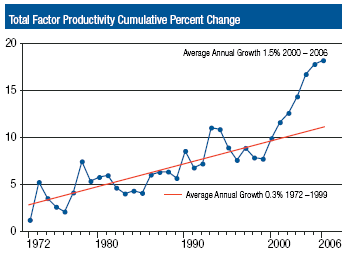
We use a single indicator to measure productivity, which is called total factor productivity (TFP). TFP measures the change in the relationship between outputs, or workload, and all the resources used in producing these outputs. Our main output is delivered mail, special services and carrier service to an expanding delivery network. Our main inputs include labor, materials, transportation and capital deployed.
During 2006, TFP improved 0.4%. This improvement is equivalent to $255 million in expense reductions and marks our seventh consecutive year of TFP growth, equivalent to an expense reduction of $7.0 billion over this time. Weighted mail volume grew 0.3% and other outputs grew by 2.8% and, when combined with 1.5% delivery point growth, yielded an 0.8% increase in workload. We were able to achieve TFP growth by holding increases in resources usage to a lower level than the increase in workload. The following graph shows the development of TFP since 1971.
Capital Investments
The Board of Governors approves the budget for investments in capital each year. The Board also approves all major capital projects, generally defined as projects greater than $25 million. Fiscal Year 2006 began with 44 Board-approved projects in progress, representing $6.5 billion in approved capital. During the year, the Board approved 8 new projects which totaled $882 million in capital. A total of 15 projects representing $1.2 billion in approved funding were completed. Thus, the year ended with 37 open projects amounting to $6.2 billion in approved capital.
While the funding for a project is authorized in one year, the commitment or contract to purchase or build may occur over several years. By year end, approximately $5.1 billion had been committed on these 37 projects. Actual payment for these projects, or capital cash outlays, will also occur over several years. Through the end of 2006, approximately $3.5 billion has been paid for the 37 projects.
Of the 37 active Board-approved projects, 25 were for mail processing equipment, 9 for facilities and 3 for other projects such as retail equipment and human resources shared services.
Our total capital commitment plan for 2007 is $3.5 billion, with cash outlays planned at $2.2 billion, of which approximately $1.5 billion are for commitments made in prior years and the remaining $700 million for new commitments in 2007.
Our capital plan supports future needs in developing and implementing new automation equipment that will increase our operating efficiency. These programs will reduce workhours in our distribution, processing and delivery operations. Our primary focus will be on projects that generate a high return on investment. We will continue to invest funds to maintain our infrastructure, including facilities, vehicles and technology systems.
Our facilities program will continue to address life, health, safety and security issues. We will invest in facilities to support our network requirements. We intend to maintain our infrastructure through high priority replacement projects and ongoing repair and alteration projects.
Financing Activities
DEBT
As an “independent establishment of the executive branch of the United States government,” we receive no tax dollars for ongoing operations. We are self supporting, and have not received an appropriation for operational costs since 1982. The last time we received any substantial contribution of capital from the U.S. government was in calendar year 1977. We fund our operations chiefly through cash generated from operations. However, unlike companies in the private sector, we are not permitted to raise capital through the equity markets. Consequently our only long term source of outside capital is through borrowing. The uncertainty of the rate setting process influences our cash management strategy.
The amount we borrow is largely determined by the difference between our cash flow from operations, our escrow requirement, and our capital cash outlays. Our capital cash outlays are the funds invested back into the business for capital investments in new facilities, new automation equipment and new services. On September 30, 2006, after placing $2,958 million into a restricted escrow account, we borrowed $2.1 billion to fund our capital and operational needs.
In 2005 we paid off all existing debt through cash flows created by “savings” from P.L.108-18. This was the first time since the Postal Reorganization Act of 1970 that we ended the year with no debt obligations outstanding.