
 Download


WASHINGTON, DC — The U.S. Postal Service Chief Financial Officer and Executive Vice President
H. Glen Walker will be on hand at the Smithsonian National Postal Museum on Oct. 1 to dedicate a series of stamps meant to draw attention to the global role of polar scientific research.
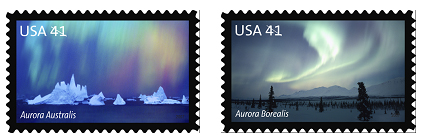
The two 41-cent Polar Lights stamps feature the aurora borealis and the aurora australis, or the northern and southern lights, meteorological phenomena that have been part of human folklore since the dawn of history. Today, the polar auroras are the subject of scientific investigation as part of the International Polar Year, a multinational research program that will focus on the Artic and Antarctic until March 2009.
“Beyond their obvious beauty, these stamps also carry a message,” said Walker. “Just as it is our privilege to enjoy the wonders of nature, it is also our duty to preserve and protect these wonders.”
Also scheduled to make remarks at the First-Day-of-Issue ceremony are Allen Kane, director of the Smithsonian National Postal Museum, and Cheryl Ganz, the museum’ acting chief curator for philately. “The Smithsonian National Postal Museum is very pleased to host the First-Day-of-Issue ceremony for the Polar Lights stamps,” said Kane. “U.S. postage stamps tell the story of the nation’ history, heroes and heritage. The National Postal Museum brings these stories to life through its exhibits and programs.”
The Postal Service produced 80 million of the stamps in panes of 20 which were designed by Falls Church, VA-based artist Phil Jordan. The photograph of the northern lights is the work of Fred Hirschmann of Wasilla, Alaska; the photograph of the southern lights is by German photographer Per-Andre Hoffmann.
Starting Oct. 1, the Polar Lights stamps can be purchased online at the Postal Store at www.usps.com/shop, by calling toll-free 800-STAMP-24, at philatelic centers nationwide and at local Post Offices.
Polar Lights Backgrounder
Oct. 1, 2007, the U.S. Postal Service will issue this pane of 20 41-cent stamps with two designs that feature photographs of the polar lights, often known as auroras.
The polar lights are a luminous glow seen in the night sky at high latitudes surrounding the north and south magnetic poles. These auroras are the result of a magnetic storm — when Earth’ magnetic field is unusually active due to a dynamic interaction with the Sun. During magnetic storms, energetic electrons descend from space and collide with molecules in the upper atmosphere, leading to the emission of green and sometimes red light. Auroras come in different visual forms, including arcs, curtains and rays, and are a relatively common sight in Alaska, Canada and northern Europe. During particularly intense magnetic storms, auroras can occasionally be seen in some of the lower 48 states as well.
“Aurora” is the Latin name of the ancient Roman goddess of the dawn. The aurora borealis are the northern lights, and the aurora australis are the southern lights. Through history, auroras have inspired a colorful folklore, especially among northern Europeans and the Inuit people of Siberia and North America, where the lights have been attributed to human or animal spirits and have sometimes been thought to foretell ominous news. Today, the aurora is the subject of scientific investigation, with researchers from many countries collaborating during International Polar Year 2007–2008.
The two designs on this pane of 20 stamps feature photographs of auroras. The photograph of the aurora borealis, the northern lights, was made by Fred Hirschmann of Wasilla, AK. It shows the northern lights over the Talkeetna Mountains in Alaska. The photograph of the aurora australis, a phenomenon of the southern polar region, was made by Per-Andre Hoffmann of Stuttgart, Germany who resides in Manila, Philippines.
The header image on the pane of stamps is a photograph of the aurora borealis by LeRoy Zimmerman of Ester, AK. Phil Jordan of Falls Church, VA, was artistic designer.
Jeffrey Love of the U.S. Geological Survey served as a scientific consultant to the U.S. Postal Service for this project. He also wrote the text that appears on the back of the stamp pane.
The two stamps on this pane of 20 were featured on the International Polar Year 2007–2008 souvenir sheet in February.
Eighty million of the Polar Lights stamps were printed. For more information on the Polar Lightscommemorative stamps, visit http://www.usps.com/communications/newsroom/2007stamps/.
Text on back of pane:
"Often known as the aurora, after the Latin name of the ancient Roman goddess of the dawn, the polar lights are a luminous glow seen in the night sky at high latitudes surrounding the north and south magnetic poles. The beautiful sight is a result of a magnetic storm, when Earth's magnetic field is unusually active due to a dynamic interaction with the Sun. During magnetic storms, energetic electrons descend from space and collide with molecules in the upper atmosphere, leading to the emission of green and sometimes red light. Throughout history, the polar lights have inspired a colorful folklore; today the aurora is the subject of scientific investigation as part of the international Polar Year, with many nations collaborating to understand this and other fascinating phenomena."
Text on back of each stamp:
"The northern lights or aurora borealis are a common sight in the northern polar region; here they appear over the Talkeetna Mountains in Alaska. During particularly intense magnetic storms, aurora borealis can occasionally be seen in some of the lower 48 states as well."
"The southern lights or aurora australis are the polar lights as seen in the Southern Hemisphere. Auroras often appear in visual forms that combine aspects of arcs, curtains, and rays; this photograph shows an aurora over Antarctica, where hints of red indicate particularly strong magnetic activity in space."
Marginal Markings:
Front: ©2006 USPS • Plate position diagram • Price ".41 x 20 = $8.20" • 4 Plate Numbers •
Back: Descriptive text on back of stamp • Barcode "461900" • USPS Logo •
Philatelic Products
There are five philatelic products available for this stamp issue:
- 461963 – First-Day Cover Set of 2, $1.58
- 461968 – Digital Color Postmark Set of 2, $3.00
- 461991 – Ceremony Program, $6.95
- 461993 – First-Day Cover Keepsake, $9.68
- 461999 – Digital Color Postmark Keepsake, $11.20
How to Order First-Day Covers
Stamp Fulfillment Services also offers first-day covers for new stamp issues and Postal Service stationery items postmarked with the official first-day-of-issue cancellation. Each item has an individual catalog number and is offered in the quarterly USA Philatelic catalog. Customers may request a free catalog by calling 800-STAMP-24 or by writing to:
INFORMATION FULFILLMENT
DEPT 6270
US POSTAL SERVICE
PO BOX 219014
KANSAS CITY MO 64121-9014
How to Order the First-Day-of-Issue Postmark
Customers have 60 days to obtain the first-day-of-issue postmark by mail. They may purchase new stamps at their local Post Office, at The Postal Store website at www.usps.com/shop, or by calling 800-STAMP-24. They should affix the stamps to envelopes of their choice, address the envelopes (to themselves or others), and place them in a larger envelope addressed to:
POLAR LIGHTS STAMPS
POSTMASTER
SPECIAL CANCELLATIONS
PO BOX 92282
WASHINGTON DC 20090-9998
After applying the first-day-of-issue postmark, the Postal Service will return the envelopes through the mail. There is no charge for the postmark. All orders must be postmarked by Nov. 30, 2007.
# # #
Please Note: For broadcast quality video and audio, photo stills and other media resources, visit the USPS Newsroom at http://about.usps.com/news/welcome.htm.
For reporters interested in speaking with a regional Postal Service public relations professional on this issue, please go to http://about.usps.com/news/media-contacts/usps-local-media-contacts.pdf.
A self-supporting government enterprise, the U.S. Postal Service is the only delivery service that reaches every address in the nation, 151 million residences, businesses and Post Office Boxes. The Postal Service receives no tax dollars for operating expenses, and relies on the sale of postage, products and services to fund its operations. With 32,000 retail locations and the most frequently visited website in the federal government, usps.com, the Postal Service has annual revenue of more than $65 billion and delivers nearly 40 percent of the world’s mail. If it were a private sector company, the U.S. Postal Service would rank 35th in the 2011 Fortune 500. Black Enterprise and Hispanic Business magazines ranked the Postal Service as a leader in workforce diversity. The Postal Service has been named the Most Trusted Government Agency for six years and the sixth Most Trusted Business in the nation by the Ponemon Institute.
Follow USPS on Twitter @USPS_PR and at Facebook.com/usps.

