
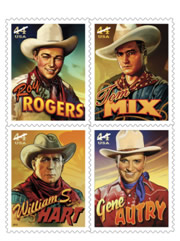
 BENTON, Kan. — Four new U.S. postage stamps honoring Cowboys of the Silver Screen will be celebrated at a ranch near the historic Chisholm Trail in Benton, Kan., on April 17.
The new stamps honor four extraordinary performers who helped make the American Western a popular form of entertainment. Film stars from the silent era through the singing era are featured on the stamps: William S. Hart, Tom Mix, Gene Autry, and Roy Rogers.
A temporary Post Office will be setup inside the Silver Screen Museum at the Prairie Rose Chuckwagon, 15231 SW Parallel St. in Benton from 5 p.m. to 6:30 p.m., on April 17, to sell the new stamps and offer a collectible First-Day-of-Sale Postmark. The postmark is free and can be applied to virtually anything with First-Class postage affixed. A souvenir envelope will also be available.
Those attending the event will enjoy free tours of the Silver Screen Cowboy Museum by an expert on movie star cowboys, free drinks and popcorn, and free movies at the Happy Trails Theatre featuring the four silver screen cowboys depicted on the stamps. Those wanting to stay for the chuckwagon dinner and show, featuring the music of Roy Rogers and Gene Autry, will need to make reservations by calling 316-778-2121. More information on the Prairie Rose is available at prairierosechuckwagon.com.
“We encourage everyone to come out and help us celebrate the release of these new stamps,” said Acting Benton Postmaster Jeannine Neil.
“This event will be a lot of fun for the whole family,” said Prairie Rose Operations Manager Orin Friesen. “It’s a great opportunity to reconnect with a bygone era and introduce these silver screen cowboys to a new generation.”
The special postmark is also available through the mail for 30 days following the event. Customers should affix first-class postage to postcards or envelopes of their choice, address the postcards/envelopes (to themselves or others), and place them in a larger envelope addressed to: Cowboys of Silver Screen Postmark, 136 S Main St., Benton, KS 67017-9998. After applying the postmark, the Postal Service will return the envelopes through the mail. There is no charge for the postmark. All orders must be postmarked by May 17, 2010.
The Cowboys of the Silver Screen stamps official First-Day-of-Issue dedication ceremony will be held April 17, at the National Cowboy & Western Heritage Museum in Oklahoma City, Oklahoma. The stamps will be available in panes of 20 stamps, as well as booklets of 20 stamped postal cards. The stamps go on sale nationwide April 17.
Following is some background information on those featured on the Cowboys of the Silver Screen stamps:
William S. Hart
William S. Hart (1864-1946) brought a powerful presence and serious approach to early Westerns. Tall and trim, with acting skills honed by years of experience on the New York stage and in productions across the country, Hart became one of the most popular leading men of the silent film era. In his movies, the actor insisted on authentic depictions of the Old West and its people, from their clothes to their lifestyles and complex personalities. He frequently played the stalwart, tough-as-nails cowboy, and his favorite horse was a brown and white pinto named Fritz.
Freelance Artist Robert Rodriguez based his portrait of William S. Hart on a likeness of the actor that appeared on a poster for the epic film Tumbleweeds (1925).
Tom Mix
Tom Mix (1880-1940) was one of the most celebrated Western film stars of the 1920s. He wowed movie crowds and live audiences alike with his daredevil riding, expert rope handling, unerring marksmanship, and rugged good looks. He also served as a role model for a generation of schoolchildren, maintaining a wholesome screen persona that involved “no cussin’ and no drinkin’” by his characters. A legend in his own time, Mix wore oversize Stetsons, fancy suits, and handmade Texas boots with engraved silver spurs. He rode “Tony, the wonder horse,” who also became an audience favorite.
Rodriguez based his portrait of Tom Mix on a likeness of the actor that appeared on the Cupid’s Round Up (1918) movie poster.
Gene Autry
For more than two decades, Gene Autry (1907-1998) entertained movie audiences and won the hearts of millions of fans with his distinctive singing style and easygoing personality. His sorrel-colored horse, Champion, often played a major role in his films, as did frequent sidekicks Smiley Burnette and Pat Buttram. Aside from being one of the most admired cowboys to ever appear on the silver screen, Autry left behind a legacy that includes many hit records, a long-running radio show, and a successful television series.
Rodriguez based his portrait of Gene Autry on a likeness of the actor that appeared on a poster for the film Gold Mine in the Sky (1938).
Roy Rogers
Roy Rogers (1911-1998) was a silver screen cowboy who sang his way to stardom. He always played the Western hero, with a warm smile, good character, and strong values. Although he found great success in show business—beginning with his first starring role, in a 1938 film—his modest roots kept him a down-to-earth country boy that Americans couldn’t help but admire. For decades, children across the country aspired to be like him and tried to live by the Roy Rogers code of conduct, which stated that boys and girls should “be neat and clean” and “always obey their parents.”
Rodriguez based his portrait of Roy Rogers on a selection of vintage Rogers materials.
# # #
Please Note: For broadcast quality video and audio, photo stills and other media resources, visit the USPS Newsroom at www.usps.com/communications/newsroom/welcome.htm.
A self-supporting government enterprise, the U.S. Postal Service is the only delivery service that reaches every address in the nation, 150 million residences, businesses and Post Office Boxes. The Postal Service receives no direct support from taxpayers. With 36,000 retail locations and the most frequently visited website in the federal government, the Postal Service relies on the sale of postage, products and services to pay for operating expenses. Named the Most Trusted Government Agency five consecutive years and the sixth Most Trusted Business in the nation by the Ponemon Institute, the Postal Service has annual revenue of more than $68 billion and delivers nearly half the world’s mail. If it were a private sector company, the U.S. Postal Service would rank 28th in the 2009 Fortune 500.
