


|
What: |
The United States Postal Service in Marshfield Hills MA will celebrate the 100th Birthday of renowned painter Andrew Wyeth with a special dedication of the recently released Andrew Wyeth Forever Stamp series. |
|
Who: |
Greater Boston District Manager Mike Rakes, WATD personality Rob Hakala and Marshfield Hills General Store Manager Tish Vivado |
|
Where: |
Marshfield Hills Post Office |
|
When: |
Friday, July 14, 2017 at 7 a.m. |
|
Background: |
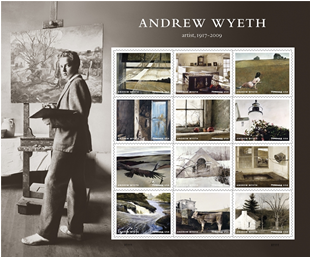
Andrew Wyeth, one of the most prominent artists of the 20th-century — whose realistic style defied artistic trends — was commemorated recently with the issuance of 12 Forever stamps highlighting his paintings. The Andrew Wyeth Forever stamps were unveiled in his home town of Chadds Ford, PA, at the Brandywine River Museum of Arton July 12, 2017 Mastering a realistic style, Wyeth (July 12, 1917 – Jan. 16, 2009) created haunting and enigmatic paintings based largely on people and places in his life, a body of work that continues to resist easy or comfortable interpretation. “The Postal Service takes tremendous pride in its stamp program, which celebrates the very best of American life, history and culture,” said Patrick Mendonca, U.S. Postal Service Senior Director, Office of the Postmaster General and Chief Executive Officer, who dedicated the stamps. “And since today is the centennial of Andrew Wyeth’s birth, it’s the perfect occasion to celebrate the man whose masterful works have found a place in our homes — and in our hearts. Wyeth’s work resonated with millions of art enthusiasts around the globe. Now, these miniature works of art can touch many.” The Andrew Wyeth Forever stamp pane includes 12 stamps that feature details of different Wyeth paintings. First row, L to R: “Wind from the Sea” (1947), “Big Room” (1988) and “Christina’s World” (1948). Second row, L to R: “Alvaro and Christina” (1968), “Frostbitten” (1962) and “Sailor’s Valentine” (1985). Third row, L to R: “Soaring” (1942–1950), “North Light” (1984) and “Spring Fed” (1967), Fourth row, L to R: “The Carry” (2003), “Young Bull” (1960) and “My Studio” (1974). The selvage shows a photograph of Wyeth from the 1930s.
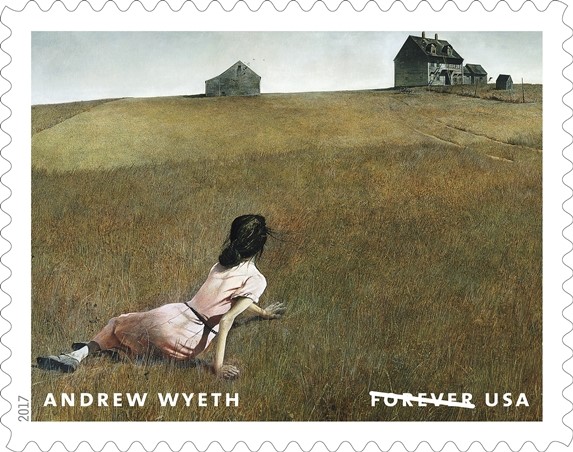
“Christina’s World,” inspired by Christina Olson, a disabled neighbor in Maine, is a rich and enigmatic work that inspired decades of interpretation. The Museum of Modern Art in New York City purchased the painting in 1948. Today, “Christina’s World” is one of the iconic works of 20th-century American art. From the sale of “Christina’s World” to the sensational “Helga pictures” unveiled in the 1980s, Wyeth captured the imagination of the American public and established himself as one of the most prominent American artists of the 20th century. Finding endless inspiration both in his hometown of Chadds Ford, PA, and in rural Maine, he scrutinized the lives, houses, and personal belongings of the people around him, sometimes painting their portraits but just as often using objects and places to represent them. Conveying emotions that were difficult to put into words, Wyeth’s work stood out for its startling austerity and stark lack of color — the artist’s way of reflecting memories, associations, and echoes from his life, including his own distinctive sense of the wondrous and the strange. In 2017, the centennial of Wyeth’s birth offers an occasion to look anew at a lifetime of remarkable art. With its subtle symbolism and eerie implications, his work invites us to reinterpret his personal vision — and to learn to see layers unnoticed before. Wyeth’s InspirationThe son of renowned illustrator N.C. Wyeth, Wyeth was born and raised in Chadds Ford. He and his wife lived there while typically spending each summer and early fall in Maine. In both places, he scrutinized the lives, houses, and personal belongings of the people around him, finding particular inspiration in the German immigrants on a nearby Chadds Ford farm and often painting portraits of them and views in and around their home. By this time, the tendencies that define much of his work were taking shape, among them a focus on death and loss; the use of places and objects to serve as stand-ins for people; an intense and unsentimental scrutiny of nature; and an often startling austerity and stark lack of color. Rather than depict nature with photographic accuracy, however, Wyeth used painting to convey emotions that were difficult to put into words. His work often reflected memories, associations, and echoes from his personal life, including his own distinctive sense of the wondrous and the strange. Wyeth received the Presidential Medal of Freedom in 1963 and the Congressional Gold Medal in 1990. Sites in Pennsylvania and Maine that influenced his work were recently designated National Historic Landmarks. Issued as Forever stamps, they will always be equal in value to the current First-Class Mail 1-ounce price. The Postal Service receives no tax dollars for operating expenses and relies on the sale of postage, products and services to fund its operations. |
# # #
Please Note: For broadcast quality video and audio, photo stills and other media resources, visit the USPS Newsroom at about.usps.com/news/welcome.htm.
For reporters interested in speaking with a regional Postal Service public relations professional, please go to about.usps.com/news/media-contacts/usps-local-media-contacts.pdf.
Follow us on twitter.com/USPS and like us at facebook.com/USPS. For more information about the Postal Service, go to usps.com and usps.com/postalfacts.
