


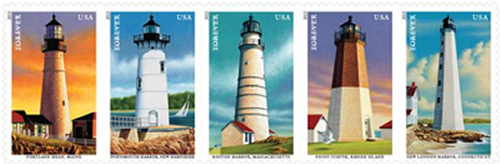
PORTLAND — The U.S. Postal Service continues its popular stamp series with the 2013 issuance of New England Coastal Lighthouses. The five featured lighthouses, among the oldest in the United States, are Portland Head, Portsmouth Harbor, Boston Harbor, Point Judith, and New London Harbor.
Stamp dedication ceremonies will be held simultaneously at or near each site at 10 a.m. on July 13. Details of the events are in the works and will be announced in June.
Each of the five new stamps features an original acrylic painting by Howard Koslow based on recent photographs of the lighthouses. The art directors were Howard E. Paine and Greg Breeding.
In addition to many other stamp projects, Koslow has produced the art for the entire Lighthouses series: the five lighthouses in the 1990 stamp booklet; the Great Lakes Lighthouses stamps issued in 1995; the Southeastern Lighthouses stamps in 2003; the Pacific Lighthouses stamps in 2007; and the Gulf Coast Lighthouses stamps in 2009.
The waters off the coast of New England have been a highway for ships since the earliest explorers came from Europe. The warm Gulf Stream flows from south to north, while the cold Labrador Current flows from north to south; these two currents make up the lanes of the highway, carrying ships along the busy Atlantic Coast. But the coastal waters are treacherous, the rocks and shoals a constant danger, and the changeable weather a challenge to navigation. New England’s lighthouses have guided ships to safe harbor and saved countless lives while guarding this coast for almost 300 years.
Portland Head
Maine’s oldest lighthouse, Portland Head was established in 1791. The construction of the tower was among the first acts of the Lighthouse Establishment, a federal agency created in 1789. The original rubblestone lighthouse still stands and looks much as it did in the late 1800s.
The 80-foot lighthouse had two types of Fresnel lenses during its history, a second-order and a fourth-order. The lighthouse was automated in 1989, and a modern DCB-224 optic installed. A beautiful Victorian keepers’ duplex, built on the station in 1891, now houses the Museum at Portland Head Light. The lighthouse has been listed on the National Register of Historic Places since 1973 and is owned and managed by the Town of Cape Elizabeth, Maine.
The tower and the keepers' house together are considered one of the most beautiful stations in the U.S., and they are among the most frequently photographed subjects in Maine.
Portsmouth Harbor
The first navigational aid in New Hampshire was established in Portsmouth Harbor, the state’s only deep-water port. Although citizens had demanded a lighthouse as early as 1721, it was not until 50 years later that the Portsmouth Harbor's first beacon was lit. An iron lantern topped the 50-foot shingled tower; three copper lamps provided the light. The 1771 tower was replaced in 1804 by another tower constructed of wood, located some 100 yards to the south of the original site.
When the second wooden tower succumbed to deterioration, a new 48-foot tower of bolted cast-iron plates was built on its foundation. It was actually assembled inside the old structure, which was dismantled after construction.
Managed by the Friends of Portsmouth Harbor Lighthouses, the 1878 lighthouse still stands on the northeast point of Great Island on the Piscataqua River in New Castle. It retains its fourth-order Fresnel lens. The lighthouse was automated in 1960 and has been on the National Register of Historic Places since 2009.
Boston Harbor
Boston Harbor Light, North America’s first true light station, was built in 1716 at the urging of the city's business community. Three years later a cannon—America’s first fog signal—was added to the light station. During the Revolutionary War, as British forces abandoned the area in 1776, they demolished the lighthouse by blowing it up.
A new rubblestone tower, 75-feet tall, replaced the destroyed lighthouse in 1783; it was raised an additional 14 feet in 1859, when its current second-order Fresnel lens was also installed. After large cracks appeared in the east wall in 1809, iron hoops were installed for support; aluminum bands replaced the corroded iron in 1973–74.
The lighthouse was designated a National Historic Landmark in 1964. Standing on Little Brewster Island within the Boston Harbor Islands National Recreational Area, it was the last lighthouse in the United States to be automated—in 1998—and is the only remaining American lighthouse to have a resident keeper employed by the federal government.
Point Judith
Located at the entrance to Narragansett Bay in Rhode Island, Point Judith Lighthouse guards a particularly dangerous area of the Atlantic. The point, which extends several miles into the Atlantic, has seen many shipwrecks, even after the addition of the lighthouse.
The first lighthouse built on the site, in 1810, was a wooden tower that toppled over in a storm five years later. A second tower, made of sturdier stone, was erected in 1816; its lamps and lenses were operated by clockwork mechanism powered by a 288-pound weight. This 35-foot tower remained in service until 1857, when the current lighthouse was built. The octagonal tower, made from brownstone blocks, stands 51 feet high and boasts a fourth-order Fresnel lens.
Automated in 1954, the lighthouse underwent a major restoration in 2000 using blocks from the same area where the original stone was quarried. The lighthouse stands on the Coast Guard Station Point Judith and has been listed on the National Register of Historic Places since 1988.
New London Harbor
Connecticut’s oldest and tallest lighthouse, New London Harbor Lighthouse, was originally established in 1761. Financed by a lottery held by the Connecticut colonial legislature, the first lighthouse was a 64-foot tower that included a wooden lantern.
The tower developed a crack and was replaced in 1801 by the present lighthouse. New London Harbor was one of the earliest American lighthouses with a flashing light, added in 1801 to distinguish it from the lights of nearby homes.
The octagonal brownstone structure is 89 feet high and retains its fourth-order Fresnel lens, which was installed in 1857. The lighthouse was automated in 1912, and the keeper’s house was sold. In 1990 it was listed on the National Register of Historic Places. Though the keeper’s house is privately owned, the New London Maritime Society acquired the lighthouse in 2010.
*Note: Boston Harbor Light is also commonly called Boston Light.
Verso Text:
Solitary and mysterious, lighthouses have fascinated people for centuries. Celebrating the eternal appeal of these historic beacons, the U.S. Postal Service continues its popular series of lighthouse stamps. Sought after by collectors and beloved by the public, this latest issuance in the series celebrates New England Coastal Lighthouses.
Portland Head
Maine’s oldest lighthouse, Portland Head has been listed on the National Register of Historic Places since 1973. The lighthouse tower, constructed in 1791, and the Victorian keepers’ house, now the home of a museum, are among the most beautiful―and most frequently photographed―stations in the United States.
Portsmouth Harbor
The first navigational aid in New Hampshire was created in 1771 in the state’s only deep-water port, Portsmouth Harbor. The present lighthouse, a 48-foot tower of bolted cast-iron plates built in 1878, was constructed inside its predecessor, a wooden tower that had succumbed to deterioration.
Point Judith
Originally established in 1810 to guard a particularly dangerous part of the Atlantic coast of Rhode Island, Point Judith’s current lighthouse was built in 1857. In 2000, the lighthouse underwent a renovation using brownstone quarried from the same area as the 1857 tower.
New London Harbor
New London Harbor is Connecticut’s oldest and tallest lighthouse. Originally established in 1761, the tower was financed by a lottery held by the Connecticut colonial legislature. The present lighthouse, built in 1801, was one of the earliest American lighthouses with a flashing beacon.
Boston Harbor
Boston Harbor Light, North America’s first true light station, was established in 1716. The lighthouse was the last in the United States to be automated―in 1998―and is the only remaining American lighthouse with a resident keeper employed by the federal government. It was designated a National Historic Landmark in 1964.
# # #
Please Note: For media interested in attending the National Postal Forum, please contact Toni DeLancey at toni.g.delancey@usps.gov.
Please Note: For broadcast quality video and audio, photo stills and other media resources, visit the USPS Newsroom at http://about.usps.com/news/welcome.htm.
For reporters interested in speaking with a regional Postal Service public relations professional, please go to http://about.usps.com/news/media-contacts/usps-local-media-contacts.pdf.
A self-supporting government business, the U.S. Postal Service is the only delivery service that reaches every address in the nation, 151 million residences, businesses and Post Office Boxes. The Postal Service receives no tax dollars for operating expenses, and relies on the sale of postage, products and services to fund its operations. With nearly 32,000 retail locations and the most frequently visited website in the federal government, usps.com, the Postal Service has annual revenue of more than $65 billion and delivers nearly 40 percent of the world’s mail. If it were a private sector company, the U.S. Postal Service would rank 35th in the 2011 Fortune 500. In 2011, the U.S. Postal Service was ranked number one in overall service performance, out of the top 20 wealthiest nations in the world, Oxford Strategic Consulting. Black Enterprise and Hispanic Business magazines ranked the Postal Service as a leader in workforce diversity. The Postal Service has been named the Most Trusted Government Agency for six years and the sixth Most Trusted Business in the nation by the Ponemon Institute.
Follow the Postal Service on twitter.com/USPS and at facebook.com/USPS.
