


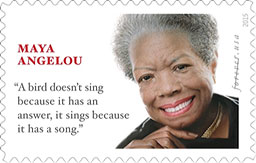
A high-resolution image of the stamp is available for media use only by emailing congetta.chirichello@usps.gov
NEW YORK CITY — The USPS New York District joins in the celebration – hosted by ESPER- the Ebony Society of Philatelic Events and Reflections and the National Park Services – which will celebrate Dr. Maya Angelou’s life. Her inspirational attributes brought her global recognition as an icon and national treasure. On August 20, 2015 at the Fred Weiss Building and African American Burial Grounds National Monument a special stamp unveiling will be held in her honor. The ceremony will take place before the capacity crowd inside the federal building lobby on Broadway in lower Manhattan. Angelou fans are encouraged to share the news on social media using the hashtag #MayaForever. Earlier this year the USPS issued a Forever Stamp in her honor.
“Maya Angelou was an author who broke down the barriers of literary form,” said Lorraine Castellano District Manager for the New York District, USPS. “Throughout her many written works, she explored themes of identity, race and displacement — and did so in a distinct style that stretched over time and place. Her stories embodied the pain of her personal struggle — but more than anything else, they epitomized the triumph of courage and the human spirit. She committed her life to ideas that elevated our sense of what it means to be human, and to advance understanding, compassion, and reconciliation.” The USPS is privileged to honor her on Forever stamps.
Also attending the ceremony will be a vast array of distinguished special guest speakers who will be announced closer to the event date.
As an author, poet, actress, and champion of civil rights, Angelou (1928–2014) was one of the most dynamic voices in 20th-century American literature. The book, “I Know Why the Caged Bird Sings,” an autobiographical account of her childhood, gained wide acclaim for its vivid depiction of African-American life in the South.
The stamp showcases Rossin’s 2013 4 feet by 4 feet oil-on-canvas portrait of Angelou. The large hyper-realistic painting is part of the Smithsonian National Portrait Gallery's collection, where it will be on display through Nov. 1.
The stamp pane includes a short excerpt from Angelou’s book, “Letter to My Daughter.” It reads: “Try to be a rainbow in someone’s cloud.” Art director Ethel Kessler of Bethesda, MD, designed the stamp.
Angelou’s Life
Angelou was born Marguerite Ann Johnson on April 4, 1928, in St. Louis, MO, to Bailey Johnson, a World War I veteran, and Vivian Baxter Johnson, a nurse. Her older brother Bailey, Jr., first called her Maya. Her parents eventually divorced, and when she was three, Maya and Bailey were sent to live with their paternal grandmother Annie Henderson, in Stamps, AR. “Momma,” as her grandchildren called her, was kind and resourceful, but life in the small, segregated town was bleak. Angelou later wrote that “high spots in Stamps were usually negative: droughts, floods, lynchings and deaths.”
Childhood
After moving back to St. Louis to live with her mother, Angelou suffered unimaginable trauma. When she was in grade school, she was raped by Vivian's boyfriend. The man was convicted, and then murdered before he began serving his sentence. Due to an overwhelming sense of guilt over his death, she stopped speaking to anyone except her brother for five years. Inspired to read by a schoolteacher who gave her “lessons in living,” Angelou began to heal and transcend the trauma of rape, in part by immersing herself in the works of William Shakespeare and Paul Laurence Dunbar, among others.
Teenage Years Transition
As a teenager, Angelou moved to San Francisco to live with her mother. She studied the arts at the California Labor School and became the city's first female African-American streetcar conductor. By the 1950s, she had begun dancing and singing calypso music at clubs in San Francisco and soon married. To distinguish herself from other performers, she adopted the name “Maya Angelou,” a version of “Angelos,” her then-husband’s last name. That decade, she joined a touring cast of Porgy and Bess, recorded an album called “Miss Calypso,” and appeared in the 1957 film “Calypso Heat Wave.”
Civil Rights Movement
At the end of the 1950s, Angelou moved to New York City and joined the Harlem Writers Guild. She also participated in the burgeoning civil rights movement, becoming the regional coordinator of the Southern Christian Leadership Conference appointed at the request of Dr. Martin Luther King, Jr., in 1959–60. In the early 1960s, she worked as an associate magazine editor in Cairo, Egypt, and as a writer and editor in Accra, Ghana.
Her Literary Works
Angelou eventually moved back to the United States. Devastated by the assassinations of both Malcolm X whom she admired, befriended and offered opinions on civil rights, and Martin Luther King, Jr., with whom she worked and formed a friendship with as well, she became increasingly involved in civil rights. One evening, a friend, writer James Baldwin, took her to a gathering at the home of Jules and Judy Feiffer where she shared several stories about her childhood. The next day, Judy Feiffer called Random House editor Bob Loomis and suggested that he try to persuade Dr. Angelou to write a memoir. She resisted until Loomis, she later recalled, issued this challenge: “You may be right not to attempt an autobiography, because it is nearly impossible to write autobiography as literature. Almost impossible.”
Published in 1969, “I Know Why the Caged Bird Sings,” established Angelou as a literary figure and opened the field of autobiography to women more generally. In the book, whose title is taken from a line in the poem “Sympathy” by Paul Laurence Dunbar, the pioneering author unflinchingly tells the story of her tumultuous early life in the South. “If growing up is painful for the Southern Black girl,” she wrote, “being aware of her displacement is the rust on the razor that threatens the throat. It is an unnecessary insult.”
The first of seven autobiographical volumes penned by Angelou, “I Know Why the Caged Bird Sings” became a best seller. When “Gather Together in My Name,” her second memoir, was published in 1974, Annie Gottlieb of the New York Times Book Review wrote that Dr. Angelou “writes like a song, and like the truth. The wisdom, rue, and humor of her storytelling are borne on a lilting rhythm completely her own.”
Continuing Accomplishments
As her career progressed, Angelou displayed extraordinary versatility. In the 1970s alone, she released the Pulitzer Prize–nominated poetry collection “Just Give Me a Cool Drink of Water 'Fore I Diiie,” wrote the screenplay for the film “Georgia, Georgia,” received a Tony Award nomination for her role in the play “Look Away,” and played the role of Kunta Kinte's grandmother in the acclaimed television mini-series “Roots.”
In 1982, Angelou became the lifetime Reynolds Professor of American Studies at Wake Forest University in Winston-Salem, NC. In the decades that followed, she continued to write and lecture around the country. At President Bill Clinton’s inauguration in January 1993, she recited “On the Pulse of Morning,” a poem she wrote for the event.
Seen on television by millions, the stirring recitation further elevated Angelou's status as an American icon. The performance later won a Grammy Award for Best Spoken Word Album. She also received Best Spoken Word Album Grammy Awards for “Phenomenal Woman” in 1995 and “A Song Flung Up to Heaven” in 2002.
Throughout the 1990s, Angelou remained active in the arts, appearing in movies such as “Poetic Justice “and on the children's TV show “Sesame Street.” The first feature film she directed, “Down in the Delta,” was released in 1998. She received the National Medal of Arts in 2000. In February of 2011, at a ceremony in the White House, President Barack Obama honored Angelou as a recipient of the 2010 Presidential Medal of Freedom. In 2013, she released her final autobiographical work, “Mom & Me & Mom.”
Angelou continued to tour, speak, write, and teach until the end of her life. Over the course of her career, she was awarded more than 50 honorary doctoral degrees, released several books of essays and poetry, and had a profound influence on American culture.
At the time of her death on May 28, 2014, Angelou had several works in progress. Two have been released: “Caged Bird Songs,” an album of her poetry set to music, and “Rainbow in the Cloud: The Wisdom and Spirit of Maya Angelou,” a book of quotes.
More than 80 million Maya Angelou Forever stamps were produced. Customers may purchase the stamps at usps.com/stamps, the Postal Store, at 800-STAMP24 (800-782-6724) and at Post Offices nationwide or visit ebay.com/stamps to shop for a wide variety of postage stamps and collectibles.
Philatelic Products
Nine philatelic products are available.
472624, Framed Art, $39.95.
Stamps are like miniature masterpieces that carry on the legacy of the people, events and places having played an important role in the American experience. The USPS regularly incorporates special stamp unveilings during community celebrations in cities focusing on such themes as Breast Cancer Awareness Month and Black History Month.
Find more information about the story behind stamps @ usps.com/stamps, facebook.com/uspsstamps or uspsstamps.com
# # #
Please Note: For broadcast quality video and audio, photo stills and other media resources, visit the USPS Newsroom at about.usps.com/news/welcome.htm. A complete list of the holiday shipping deadlines can be found at usps.com/holidaynews.
For reporters interested in speaking with a regional Postal Service public relations professional, please go to about.usps.com/news/media-contacts/usps-local-media-contacts.pdf. Follow us on Twitter (twitter.com/usps), Instagram (instagram.com/uspostalservice), Pinterest (pinterest.com/uspsstamps), LinkedIn (linkedin.com/company/usps), subscribe to our channel on YouTube (youtube.com/usps), like us on Facebook (facebook.com/usps) and view our Postal Postsblog (uspsblog.com).
For more information about the Postal Service, visit usps.com and usps.com/postalfacts.
