


|
WHAT: |
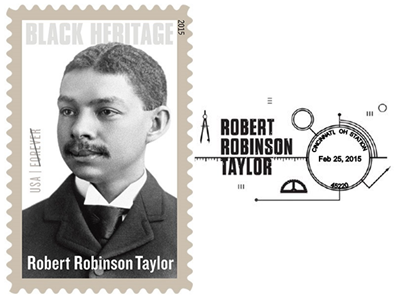
Special Dedication of the Robert Robinson Taylor Forever® stamp in conjunction with the Environmental Protection Agency’s Black History Month program |
|
WHO: |
US Postal Service and Greater Cincinnati Federal Executive Board |
|
WHEN: |
10:00 a.m., Wednesday, February 25, 2015 |
|
WHERE: |
EPA Andrew W. Breidenbach Environmental Research Center Auditorium Members of the media are invited to attend |
|
BACKGROUND |
Robert Robinson Taylor Forever® stamps Robert Robinson Taylor, believed to have been both the first African-American graduate of the Massachusetts Institute of Technology (MIT) and the nation’s first academically trained black architect was recently inducted into the Postal Service’s Black Heritage Stamp series as the 38th honoree. Taylor, the son of a slave, traveled from Wilmington, NC, to attend M.I.T. in 1882. He believed that with a good education, hard work, relentless determination and a dedication to family, there were no limits to what he could accomplish. Booker T. Washington recruited Taylor to the Tuskegee Institute to help show the world what an all-black institution could accomplish. For more than three decades, Taylor (1868–1942) supervised the design and construction of the Tuskegee Institute in Alabama while also overseeing the school’s programs in industrial education and the building trades. Through his calm leadership and quiet dignity, he earned the admiration of colleagues and students alike while expanding opportunities for African-Americans in fields that had largely been closed to them. Son of a Former Slave Taylor’s studies were rigorous. He typically spent seven hours in class per day, and by his second year was taking as many as 10 courses per semester in such wide-ranging subjects as mechanics, acoustics, structural geology, heating, ventilation and sanitation, as well as in drawing, history, English and French. He earned honors in trigonometry, architectural history, differential calculus and applied mechanics, and was always at or near the top of his class. Upon graduating, Taylor had several offers for teaching jobs, including an invitation from educator and activist Booker T. Washington to work at the Tuskegee Normal and Industrial Institute in Tuskegee, AL. Washington had founded the school in 1881 not only to help African-Americans acquire valuable practical skills, but also to show the world what an all-black institution could accomplish. Developed Tuskegee’s Architectural Curriculum Designer of Tuskegee’s Campus Taylor’s Colonial-style designs, including half a dozen buildings with grand porticos and large classical columns, were built of richly textured, multihued bricks made by the students themselves. In keeping with Washington’s belief that well-designed community buildings proved and nurtured racial progress, Taylor typically built in a style that was also consistent with his own personality: elegant, dignified and persuasive without being showy. Taylor left Tuskegee in 1899 to work and study new building methods in Cleveland, but continued to design buildings for the school. When he returned in 1902, he was given the title he held for the rest of his career: Director of Mechanical Industries. He continued to design new buildings and oversaw the Department of Mechanical Industries, which included 22 divisions that trained harness makers, tinsmiths, wheelwrights, tailors, plumbers, steamfitters and many other skilled artisans. His Inspirational Words Unfaltering Leadership Later in his career, Taylor designed or co-designed buildings beyond the Tuskegee campus as well, including a combined classroom, chapel and administrative building at Selma University; a combination office, entertainment, and retail building in Birmingham, and elegant libraries in North Carolina and Texas. In 1929, presented with a particularly interesting opportunity, he traveled to Liberia to help establish the Booker T. Washington Agricultural and Industrial Institute. He helped organize the curriculum and advised on staffing, leadership, and facilities, serving as an intermediary between missionaries, businesses, and the Liberian government; he also designed plans for the campus and its first structures. The trip was covered by the African-American press, and Lincoln University in Pennsylvania awarded him an honorary doctorate for his work. Public Service and Advocacy Following Retirement Final Moments Surrounded by his Masterpiece In her 2012 book about Taylor and Tuskegee, architectural historian Ellen Weiss writes that Taylor was eulogized for “his principled character, his organizational abilities, his special tact on interracial matters, and his achievements as an educator and architect.” Colleagues and friends recalled him as eloquent, intelligent, dignified and kind. MIT’s Influence The Robert Robinson Taylor stamp has been issued as a Forever stamp which is always equal in value to the current First-Class Mail 1-ounce price. Customers may purchase the stamps at usps.com/stamps, the Postal Store, at 800-STAMP24 (800-782-6724) and at Post Offices nationwide or visit ebay.com/stamps to shop for a wide variety of postage stamps and collectibles. Ordering Special Dedication Postmarks Robert Robinson Taylor Stamp After applying the Cincinnati Special Dedication postmark, the Postal Service will return the envelopes through the mail. There is no charge for the postmark up to a quantity of 50. For more than 50, customers are charged 5 cents each. All orders must be postmarked by Apr. 25, 2015. |
# # #
Please Note: For broadcast quality video and audio, photo stills and other media resources, visit the USPS Newsroom at about.usps.com/news/welcome.htm.
For reporters interested in speaking with a regional Postal Service public relations professional, please go to about.usps.com/news/media-contacts/usps-local-media-contacts.pdf.
Follow us on twitter.com/USPS and like us at facebook.com/USPS. For more information about the Postal Service, go to usps.com and usps.com/postalfacts.
