
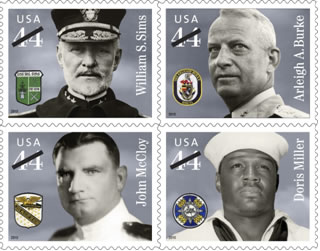
HAMPTON ROADS, VA — Four revered U.S. Navy icons will be commemorated in a First-Class salute with the dedication of the Distinguished Sailors collectable stamps on Feb. 4 . The first-day-of-issue stamp dedication ceremony will take place at the United States Navy Memorial in Washington, DC.
Available nationwide on Thursday, the 44-cent stamps immortalize four sailors who served with bravery and distinction during the 20th Century: William S. Sims, Arleigh A. Burke, John McCloy and Doris “Dorie” Miller. The stamps, designed by Phil Jordan of Falls Church, VA, are based on photographs from Navy archives. Text along the top of the stamp sheet identifies the four sailors, the approximate date of each photograph, and a ship named in honor of each sailor.
At 10 a.m. on Friday, Feb. 12, local postal officials are hosting a stamp dedication at Naval Station Norfolk to honor the four sailors as well as the crew of Burke’s namesake, the guided missile destroyer USS Arleigh Burke (DDG-51). The ship’s 1991 commissioning in Norfolk was attended by Admiral Burke.
“On behalf of the U.S. Postal Service and postal employees throughout Hampton Roads, I am pleased to honor Arleigh Burke and these other great sailors who positively impacted our community, our nation and the world,” said Jacob Cheeks, Richmond District Manager, U.S. Postal Service. “They represent the U.S. Navy’s proud legacy of service to this nation.”
Joining Cheeks in dedicating the stamps are Cmdr. Brian Moum, Commanding Officer, USS Arleigh Burke; Command Master Chief Anthony Smith, USS Arleigh Burke; and Norfolk Postmaster Richard Bennett.
William S. Sims
Commander of U.S. naval forces in European waters during World War I, Sims (1858-1936) was an outspoken reformer and innovator who helped shape the Navy into a modern fighting force. Frustrated by the Navy bureaucracy, he circumvented his superiors to get the Navy to adopt improved gunfire techniques that increased firing accuracy as ships rolled through ocean swells. He also is noted for promoting the convoy system that grouped ships closely together as they were accompanied by small numbers of Navy escorts while crossing the U-Boat infested Atlantic — saving countless lives in both world wars. The stamp features a detail from a 1919 photograph of Sims and depicts the crest of the destroyer escort USS W.S. Sims (DE-1059), commissioned in 1970.
Arleigh A. Burke
After serving as one of the top destroyer squadron commanders of World War II, Burke (1901-1996) had an equally distinguished postwar career in which he played a major role in modernizing the Navy and guiding its response to the Cold War. During World War II, he gained a reputation for brilliance and innovation while commanding Destroyer Squadron 23, known as “the Little Beavers.” The squadron fought in 22 separate actions in a four-month period, sinking or helping to sink nine enemy destroyers and downing 30 airplanes. He later served an unprecedented three terms as the Navy’s highest ranking officer — Chief of Naval Operations — to speed construction of nuclear-powered submarines and initiating the Polaris Ballistic Missile Program. His stamp, based on a 1951 photograph, depicts the crest of the guided missile destroyer USS Arleigh Burke (DDG-51), commissioned in 1991.
John McCloy
Described by a shipmate as “like a bull” who couldn’t be stopped, McCloy (1876-1945) holds the distinction of being one of the few men in the nation’s history to earn two Medals of Honor for a rescue mission during the Boxer Rebellion in which he was wounded, and during the 1914 Mexican Revolt for intentionally exposing his boat to draw enemy fire to identify their positions for retaliation by U.S. cruiser gunfire. Shot in the thigh, he remained on post 48 hours until the brigade surgeon sent him to a hospital. In 1919 he was awarded the Navy Cross as commander of USS Curlew, which engaged in the “difficult and hazardous duty” of sweeping mines in the North Sea in the aftermath of World War I. His stamp is based on a circa 1920 photograph and depicts the crest of the destroyer escort, USS McCloy (DE-1038), commissioned in 1963.
Doris Miller
The first black American hero of World War II, Miller (1919-1943) became an inspiration to generations of Americans for his actions at Pearl Harbor on Dec. 7, 1941. Serving aboard the battleship West Virginia as a mess attendant — the only job rating open to blacks at the time — Miller helped rescue scores of shipmates wounded or trapped in wreckage. He was later ordered to the bridge to help move the ship’s mortally wounded captain. Never trained in its operation, he manned an unattended 50-caliber machine gun to fire on Japanese aircraft until ordered to abandon the bridge as fires raged out of control. He was later awarded the Navy Cross. Miller was promoted in June 1943 to Officer’s Cook Third Class aboard the new escort aircraft carrier Liscome Bay and was killed in action on Nov. 24 that year along with more than 600 shipmates when an enemy torpedo sank the ship during the invasion of the Gilbert Islands. His body was lost at sea. His stamp is based on a 1942 photograph and depicts the crest of the destroyer escort USS Miller (DE-1091), commissioned in 1973. Actor Cuba Gooding Jr., portrayed Miller in the 2001 movie Pearl Harbor.
# # #
Please Note: For broadcast quality video and audio, photo stills and other media resources, visit the USPS Newsroom at www.usps.com/news.
A self-supporting government enterprise, the U.S. Postal Service is the only delivery service that reaches every address in the nation, 150 million residences, businesses and Post Office Boxes. The Postal Service receives no tax dollars. With 36,000 retail locations and the most frequently visited website in the federal government, the Postal Service relies on the sale of postage, products and services to pay for operating expenses. Named the Most Trusted Government Agency five consecutive years and the sixth Most Trusted Business in the nation by the Ponemon Institute, the Postal Service has annual revenue of more than $68 billion and delivers nearly half the world’s mail. If it were a private sector company, the U.S. Postal Service would rank 26th in the 2008 Fortune 500.
