


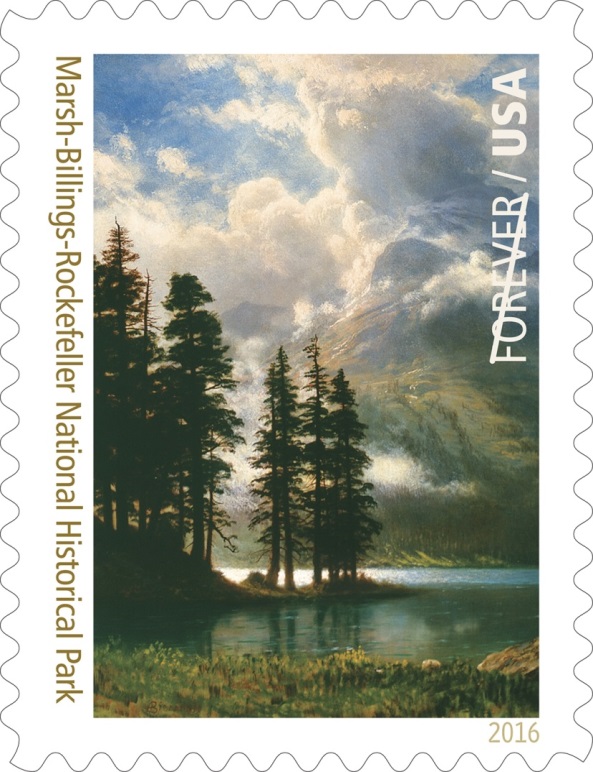
Scenery in the Grand Tetons [detail] Albert Bierstadt, Marsh-Billings-Rockefeller National Historical Park, MABI 2843.
|
What: |
A stamp image representing an iconic Hudson River School of Art landscape painting linked to the Conservation Movement that supported interest in creating the National Park system will be unveiled on Saturday, June 4, 2016. The stamp is one of 16 celebrating the National Park Service’s 100th anniversary. |
|
Who: |
Northern New England District Manager for the Postal Service John Godlewski and Marsh-Billings-Rockefeller National Historic Park’s Superintendent Rick Kendall |
|
When: |
June 4, 2016 at 10:30 a.m. as a kickoff to the parks Trek to Taste celebration |
|
Where: |
At the Marsh-Billings Rockefeller National Historical Park 54 Elm St. Woodstock VT 05091 at the Forest Center. Parking is available at the Billings Farm and Museum — across the street. |
|
Background: |
“This stamp exemplifies how our national park treasures extend beyond stunning vistas, wildlife, flora and fauna,” said Stephanie Toothman, Associate Director, Cultural Resources, Partnerships, and Science, National Park Service. “Albert Bierstadt’s painting represents the convergence of artistic, literary and political attention toward America’s scenic beauty in the 19th century, which helped establish conservation as a national value and laid the foundation for the first national parks a century ago.” The stamp image is a detail of Bierstadt’s (1830–1902) 29-by-43-inch oil-on-canvas painting “Scenery in the Grand Tetons.” The permanent home of the painting is Laurance Rockefeller’s study in the Marsh-Billings-Rockefeller Mansion. The stamp image, available for media use only, requires the following credit: Scenery in the Grand Tetons [detail] Albert Bierstadt, Marsh-Billings-Rockefeller National Historical Park, MABI 2843 The Conservation Movement and the Marsh-Billings-Rockefeller National Historical Park (NHP) According to the National Park Service, Rockefeller acquired the painting in the 1960s and added it to the collection of the Marsh-Billings-Rockefeller Mansion as “a reminder of his family’s long loyalty to Grand Teton National Park, and the preservation of the mountains, lake and valley in that spectacularly beautiful and dramatic part of the West.” The Hudson River School Art Movement According to the National Park Service, “Their landscapes sought to recreate the majesty of the natural world and to inspire admiration for its beauty.” Americans who bought their paintings and admired them on the walls of their city homes came to believe that those scenes should be preserved for future generations, not just painted or photographed. At the same time, the works of authors such as Nathaniel Hawthorne, Henry David Thoreau and Ralph Waldo Emerson also celebrated the beauty and importance of nature. Marsh-Billings-Rockefeller National Historic Park The lives and contributions of these three generations of stewardship reflect the wide range of attitudes and ideas in the evolution of the conservation movement in the United States. The site was the boyhood home of G. P. Marsh, one of America’s first conservationists, whose 1864 book, Man and Nature, decried the effects of deforestation in Vermont and around the world and provided the intellectual underpinnings of the early conservation movement. Later, it was the home of Billings, who returned to his native Vermont from California, transformed the property into a progressive farm and country estate, and reforested much of the land around the Mansion. Its most recent owners, Billings’ granddaughter Mary Rockefeller and her husband Laurance Rockefeller, gave the property and its collections to the American people, the latest in a long history of support for National Parks by the Rockefeller family. Rockefeller received the Congressional Gold Medal in 1991 for his contributions to conservation and historic preservation. Other National Park Forever Stamps previewed to date include Acadia National Park, Arches National Park, Assateague Island National Seashore, Bandelier National Monument, Carlsbad Caverns National Park , Everglades National Park, Glacier Bay National Park and Preserve, Grand Canyon National Park,Gulf Islands National Seashore,Haleakalā National ParkandKenilworth Park & Aquatic Gardens. The Postal Service receives no tax dollars for operating expenses and relies on the sale of postage, products and services to fund its operations. |
# # #
Please Note: For broadcast quality video and audio, photo stills and other media resources, visit the USPS Newsroom.
Reporters interested in speaking with regional Postal Service public relations professionals should visit this link.
Follow us on twitter.com/USPS and like us at facebook.com/USPS. For more information about the Postal Service, visit usps.com and usps.com/postalfacts.
