
Good morning, Mr. Chairman and members of the Subcommittee. I appreciate the opportunity to meet with you today to continue our conversation concerning the extreme financial difficulties being experienced by the United States Postal Service and the actions we must take to address them. Our situation is urgent and our condition has deteriorated significantly since I testified before this Subcommittee in January, but our goal remains the same: to protect the immediate and long-term viability of America’s postal system.
This is a complex and difficult task and there is no simple solution. The tools available to the Postal Service today, although enhanced by welcome new levels of pricing and product flexibility offered by the Postal Accountability and Enhancement Act of 2006, are insufficient to overcome economic conditions and unaffordable cost obligations that are contributing to a growing series of multi-billion dollar annual losses and financial instability that we expect to continue for many years to come.
Last week, the Government Accountability Office (GAO) added the Postal Service’s financial condition to its “high-risk” list, explaining that our financial viability is critical because of the vital role the Postal Service plays in the national economy.
It is important to emphasize that the problems we are facing, despite their magnitude, do not reflect, in any way, a lessening of the value of the mail. Rather, the extreme suddenness with which they arose–at a time when our annual costs began to surge more than $5 billion as the result of a new statutory obligation, and as the negative effects of the recession began to hurtle through every economic sector–indicate that the Postal Service, like any organization or business whose financial success depends on the underlying soundness of the economy, was–and is–being affected by larger market forces.
As a business tool, mail continues to offer unparalleled value in terms of targeting, pricing, measurability, and effectiveness. It continues to produce positive results for mailers who depend on it to help drive business growth. Customer satisfaction and employee engagement have never been higher. In a time marked by uncertainty, the Postal Service remains the most highly-trusted government agency -- and one of the ten most trusted organizations in America.
To be sure, the chilling effect of today’s economic climate has certainly accelerated the diversion of some mail to other channels. But it has not altered the basic strength of the mail as one of the most effective tools available for customer acquisition, customer retention, and customer growth.
In responding to the changed requirements of our changed economic situation, we have been taking cost-reduction efforts to unprecedented levels. Employees and managers at every level of the organization have brought a remarkable focus to making all of our operations more efficient and effective than ever. This will continue. And despite the severe strains the economy has created throughout the entire mailing industry, we believe that the potential of the mail remains as strong as ever.
With that in mind, we have implemented a growth strategy that is based on pricing and product innovation that offers even more value to customers. This can also serve to limit the severe volume erosion that is so closely tied to the decline in business and consumer spending that began late in 2007.
If the efforts we are making are to be successful, they must be matched by legislative efforts that address key cost and structural issues that are beyond the scope of the Postal Service’s authority and are key contributors to our precarious financial condition. These include the elimination or modification of a unique and onerous prefunding requirement–one borne by no other public- or private-sector employer–for health benefits for future retirees. The sheer size of this payment, which averages almost $5.6 billion each year from 2007 through 2016, has undermined–and will continue to undermine–our ability just to break even during that entire period, let alone generate the positive net income that was anticipated by the 2006 legislation.
Beyond the huge expense of the retiree prefunding requirement, our financial condition has
been profoundly weakened by the effects of a shrinking economy on mail volume and revenue. The retrenchment in spending has affected virtually every mailer and their customers. The consequences have been so severe that only a fundamental structural change will make it possible for the Postal Service to overcome costs that are insurmountable under our current business model.
In considering the structural changes that can produce the level of results that are necessary,
we have concluded that reducing the frequency of mail delivery from six to five days a week can provide the financial relief that is necessary to restore the fiscal health of the Postal Service. We respectfully request your support of this difficult but necessary approach through legislation that would make this adjustment possible.
This morning I will provide you with a detailed analysis of the untenable economic condition of the Postal Service today. I will share our projections about its equally disturbing financial prospects for the future. I will explain how our entire organization is working to overcome the effects of the economic forces that have undermined our business success. And, finally, I will discuss the legislative solutions that the Postal Service Board of Governors and management believe are necessary for the long-term survival of an effective, efficient, and affordable national postal system.
It all starts with service. Despite the tremendous financial pressures we are experiencing, and the enormous strains that have been placed on every element of our network, I am pleased to say that the men and women of the Postal Service are doing an exceptional job. They are focused on our customers, the American people, and they are delivering service performance that not only meets previous high levels but continues to set new records. Each of them shares my confidence in the future of the mail and, through their performance, each of them is contributing to a stronger future for everyone who depends on the mail.
As our organization continues to respond to the demands of an economy marked by contraction and uncertainty, we will not waver in our commitment to service. That is the heart of our brand. Our customers have always depended on the Postal Service for quality, reliability, trust, affordability and value. That is what they expect and that will not change. That is our job.
And that is why protecting service remains one of the primary elements in our strategy of working to protect the future of our nation’s mail system. It remains a vital and substantial contributor to
our nation’s economy–both as an enterprise and through its role connecting every American household and business.
The financial framework that supports our work and, with it, our ability to provide the levels of service our customers require, has changed drastically over the last twenty months. The pace
of that change, driven by the length and severity of the current recession, has only accelerated since January.
At that time, based on preliminary first-quarter results, I reported that we were anticipating a loss of $6 billion for fiscal year 2009. Today, as we near the mid-point of our final quarter, we expect to end the year with a loss of at least $7 billion. Despite the success of our cost reduction efforts, the volume and revenue declines are even more dramatic.
Mail volume, our measure of unit sales, has reflected both the weakness of the overall economy and its particularly harsh effects on the financial, credit, and housing markets, declining more sharply than at any time since the 1930s. Earlier in the year, we were projecting a volume decline in 2009 of 15 to 20 billion pieces compared to 2008. We now expect to close this year with actual volume of around 176 billion pieces, a year-over-year decline of 27 billion pieces, or 13 percent.
We have just filed our third-quarter financial reports. For the quarter ending June 30th, the Postal Service had a net loss of $2.4 billion, which includes a one-time accounting adjustment that increased expenses by $800 million, on revenue of $16.3 billion and expenses of $18.7 billion. Our revenue declined by 8.8 percent, driven by a volume decline of more than 14 percent. Through the first three quarters of this fiscal year, our net loss was $4.7 billion, again driven by a year-to-date volume decline of almost 20 billion pieces.
In addition, we are facing a serious liquidity issue. The growing gap between costs and revenue, even as we have increased our borrowing by the annual permissible limit of $3 billion, will result in a serious cash-flow shortage of up to $700 million for 2009.
Consequently, we will simply not have the means to meet all of our required obligations as we close the fiscal year. This will have a direct effect on our ability to meet the scheduled payment of $5.4 billion to the Postal Service Retiree Health Benefit Fund, which is required on September 30, by the Postal Accountability and Enhancement Act of 2006.
If we were to make that entire payment, the Postal Service would not have the working capital reserves to fund operations or meet its payroll obligations, both of which are critical to fulfilling our universal service mandate. We will not default on that mandate. As a result, we have notified the Administration, the members of this Subcommittee, and other Members of Congress that, absent legislative change, the Postal Service will not be in a position to meet a portion of its required September 30 payment to the Postal Service Retiree Health Benefit Fund without legislative action to modify this requirement. The Fund today contains a balance of $34 billion.
As we examine our key business indicators over the next several years, we do not see any improvement without a swift, substantial, and sustained improvement in the general economy and legislative changes that will provide needed cost relief in a number of key areas. While general inflationary pressures have moderated considerably, our network costs will continue to climb inexorably as we invest scarce resources to expand our delivery system to accommodate more than one million new households and businesses each year. With mail volume well below the level necessary to adequately finance growing network costs, the gap between revenue and expenses will widen even more. Mail volume will contract even further in 2010, with an expected decline of another 8 billion to 15 billion pieces, bringing total volume possibly as low as only 160 billion pieces–more than 20 percent below 2008 figures. While our growth initiatives will help to partially offset that decline, they will be constrained by the general weakness of the economy and the limited pace of any potential recovery.
By the end of this fiscal year, we will have reduced our career workforce by 175,000 employees–more than 20 percent below our peak of 800,000 in 1999. And we have not simply substituted noncareer employees in their place. In fact, we have reduced our reliance on temporary and seasonal employees by the same ratio. Today, they constitute the same percentage of our total complement, 12 percent, as they did ten years ago.
At the same time, the number of addresses we serve has increased from 134 million to today's 150 million. Accommodating that growth, while minimizing the staffing necessary to achieve it, has contributed to unprecedented levels of efficiency that were interrupted only by the effects of a weak economy.
As we work to respond to the intense financial pressures of the deepest and most prolonged recession our nation has experienced since the 1930s, an unwavering focus on cost reductions will remain an integral part of our strategy to protect the viability of the Postal Service. Our cost-reduction targets have been aggressive, averaging more than $1 billion per year from 2002 through 2007, and intensifying since that time.
When, early in fiscal year 2008, it became clear that the recession would negatively affect mail volume and revenue, we set–and ultimately surpassed–a goal of removing $2 billion in costs. Based on the severity of the economic slowdown, our plan for 2009 calls for an unprecedented reduction of $5.9 billion in additional costs. We are on track to exceed this goal, ending the year with more than $6 billion in cost reductions.
Throughout the organization, our managers have pursued every opportunity to meet our target of removing 100 million workhours. By the end of the third quarter, with three full months remaining in the fiscal year, the actual reduction was 87 million workhours–almost 90 percent of our goal.
We have maintained a hiring freeze since the beginning of this fiscal year, which is critical to our ability to match the size of our workforce with the steep and rapid decline in mail volume. This has been accompanied by reductions of up to 20 percent in administrative positions and the offer of voluntary early retirement opportunities to 150,000 eligible employees. We have also been adjusting scheduling, particularly in our mail processing facilities. In many locations we have eliminated work shifts so that we can better align plant staffing with the ebbs and flows of a changing workload.
Working closely with the National Association of Letter Carriers through a special, expedited process, we are reviewing more than 158,000 city delivery routes this Fiscal Year. Our goal is to identify routes that require adjustment to reflect reduced mail-delivery volumes. More than 93,000 were evaluated from October 2008 through March 2009. We are now completing evaluations and adjustments for routes not previously evaluated and reviewing those that were recently adjusted. We evaluated 18,000 routes in June and 52,000 in July. Another 82,000 are now underway. Earlier this year, through the provisions of our collective bargaining agreement with the National Rural Letter Carriers Association, we also completed a review of every aspect of our rural delivery routes. In both cases, the result will be reduced costs and increased delivery efficiency.
In addition, the last round of collective bargaining with our unions produced a notable change in the Postal Service’s share of contributions for health-benefit premiums for current employees. The resulting contracts reduce the Postal Service’s payment by one percentage point during each year they are in effect, resulting in growing, annual savings. This transfer of obligation means that employee payments increase by one percent each year.
Our plans for 2010 call for additional cost reductions of more than $3.5 billion, led by the elimination of another 80 million to 90 million work hours. We will continue the strategies that have been successful in 2009 and we will supplement them with activities that continue to improve efficiency, reduce costs, and maintain the highest levels of service.
We have begun to convert our 21 Bulk Mail Centers into Network Distribution Centers. This will greatly enhance network efficiency through greater levels of shipment consolidation, contributing to more effective utilization of the cargo capacity of mail containers and trucks. This will also allow us to move greater amounts of mail more deeply into the system earlier in the process, by reducing and eliminating expensive and time-consuming intermediate sorting, shipment consolidation, and transportation activities.
Since the mid-1990s, we have relied on automated processing technology to sort letter mail into the order in which it is delivered, contributing to improved accuracy and efficiency. We are now bringing the same efficiency to flats. Flat mail–which includes large envelopes, catalogs, magazines, and newspapers–is one of the most difficult and expensive types of mail to process, sort, and deliver because of its variations in size, thickness and address placement.
In 2008, faced with competing priorities, rapidly diminishing resources, and the need to constrain price growth for this product segment, the Postal Service made a conscious decision to proceed with its investment in flats-sequencing technology. Sequencing for flat mail is now performed manually by our letter carries at each Post Office before they begin their actual delivery duties.
As we expand automated delivery sequencing to this mail, we will achieve savings through processing improvements, increasing the amount of time available to carriers for delivery. This will help us to avoid adding new routes and make it possible to reduce existing delivery routes from current levels, an important consideration as our delivery network expands while mail volume–and the revenue it generates to support universal delivery–are both contracting more sharply than at just about any time in our history.
These same factors are driving our initiative to consolidate some of our retail stations and branches in larger cities throughout the nation. We are focusing on areas where we have a number of offices in close proximity to each other to determine where consolidations are possible. Each facility will be reviewed on a case-by-case basis. We anticipate that out of about 3,200 locations, fewer than 1,000 would be considered as viable candidates for further study and action.
While a station or a branch is similar in many ways to a Post Office, there are some significant differences, particularly from an administrative standpoint. Each of our more than 27,000 Post Offices is managed by a Postmaster and is responsible for providing access to postal services in a local geographic service area. Some Post Offices have subunits, called stations or branches, which operate under the direction of a station or branch manager, who reports to the local Postmaster. These facilities offer retail counters where customers can buy stamps, ship packages, and obtain just about all of the products and services available at a Post Office. They often offer Post Office Box service and many host carrier operations, as well.
Changes in letter- and flat-mail processing technology over time have reduced the space needed for carrier operations in the “back of the house” at many stations and branches. This has made it possible for the Postal Service to consolidate carrier operations into fewer locations without affecting delivery service. Often, space vacated by carrier operations at a particular station created opportunities to expand the space available for “front of the house” retail operations. But it is time to reexamine our retail space requirements, as well.
Today, our traditional retail network reflects needs of a different time, when there were far fewer means of alternate access to postal services, when First-Class Mail growth was very robust, and virtually all of our retail revenue was generated through transactions at our retail counters. We have responded to the demand for increased customer convenience by developing even more-accessible and economical alternate channels that offer a wide range of postal products and services.
These include our popular website, usps.com; Automated Postal Centers, self-service kiosks that weigh packages, dispense postage, and accept mailings; contract postal units, operated by independent businesses in conjunction with their primary businesses; postage stamps at Post Office prices, available at more than 50,000 non-postal retail locations; the ability of customers to order postal products by phone or mail; and the ultimate convenience of free package pickup right at their home or office.
Today, about 29 percent of retail revenue is generated through alternate channels. This continues to increase. Each year more and more customer transactions take place online without the need for customers to make a special trip to the Post Office.
Use of our website, usps.com, has grown to about 30 million customer visits each month for stamps, prepaid postage, address changes, mail holding and forwarding, free mailing supplies, free package pickup requests, and mailing information. Consistent with the Congressional mandate in the Postal Accountability and Enhancement Act of 2006, we will continue to expand alternate retail access to postal services.
Changes in customer mailing habits and the expansion of state-of-the-art technology throughout all of our operations–processing, delivery, and retail–have made it incumbent upon us to review the number and location of stations and branches and to determine if there is any excess capacity. Reevaluating the need for these facilities and determining if they are truly adding value, while providing our customers with necessary levels of service, is the type of business-like action required for the Postal Service to be able to compete in today’s marketplace and to manage its resources responsibly.
As part of this process, we have asked that our local managers consider factors that include: local customer access to our retail services; the affect any change might have on service standards; cost savings; impact on employees and the environment; real-estate values; and long-term Postal Service needs. We do not expect that this initiative will generate any changes before fiscal year 2010, which begins on October 1.
The postal workforce will continue to grow smaller as we adapt to a changed economic environment. As this occurs, it will be possible to further reduce administrative staffing while still providing the necessary levels of support for our employees and operations.
Our stringent cost-reduction activities will continue in 2011, with a target of eliminating another $3.2 billion from our base costs, but this can only be achieved if current law is modified to allow our Board of Governors to review, approve, and implement a major–and necessary–structural change to our delivery operations by moving from six-day to five-day delivery. This will also create opportunities to align administrative staffing with a new operational model.
There has been a great deal of speculation regarding the effect of five-day delivery on our household and business customers, and on mail processing and collection, as well. In our extensive planning for this change, which is an absolute requirement for the long-term viability of our nation’s postal system, we have been developing a thorough concept of operations.
First, and most importantly, weekday delivery would not change. Mail would be delivered on Monday through Friday to homes, businesses, and Post Office boxes. A reduction to five-day delivery would affect only carrier delivery and only on Saturday.
A change to five-day delivery will not affect retail operations. Post Offices with Saturday hours will remain open on Saturdays.
This adjustment would have absolutely no effect on Post Office box service. All box mail would continue to be delivered--and available--to our box customers on Saturdays. For most users, Post Office box service is an optional, value-added service designed to provide an additional level of flexibility to mail delivery and receipt, based on a customer’s individual schedule and needs.
Express Mail, our premium expedited service, which has always offered delivery on Sunday and holidays, will continue to be delivered on Saturday as well. There will be no regular Saturday delivery or collection of mail to addresses served on any city, rural, and contract delivery routes.
Remittance mail would also be available as it currently is through Post Office box or caller service at the local Post Office and, for some larger customers, at the local mail processing facility. Consisting primarily of payment by consumers to businesses, utilities, services, and financial institutions, remittance mail is an extremely important element of our nations’ economy, expediting payments valued at trillions of dollars each year. Our exceptional on-time delivery performance for this mail, independently measured in increments of hours rather than days, has become the expectation of organizations that rely on remittance mail. We will continue to meet those expectations as we work to improve on our already high performance for this mail.
We selected Saturday as a non-carrier-delivery day for a number of reasons. First, because it is the lowest-volume delivery day, but with same level of fixed costs as other delivery days, discontinuing Saturday delivery offers the maximum benefits to our business. It will also minimize the inconvenience to our customers. Most business and professional offices are open Monday through Friday, with many closed on Saturday.
We recognize that if we were to eliminate delivery during the regular business week, some business customers would only receive mail on four days each week. These customers have been clear about their needs, which are consistent with our approach, and we will honor those needs.
We will continue to collect and process locally originating mail on Monday through Friday. This is mail that enters our system within the immediate service area of a local mail-processing plant.
Processing for destinating mail–mail received for delivery within the service area of a local processing facility–will vary. Mail for delivery to street addresses will be processed on Monday through Friday. Post Office box mail will be processed Mondays through Saturdays. Remittance mail will be processed seven days each week at our plants, where our largest customers come to pick up their mail.
The changes in processing activities will not affect our acceptance of destinating drop-ship mail at these locations on Saturdays. We will be staffed to accept this mail. This will support our ability to continue providing exceptional value to these mailers.
For the last several months, a cross-functional team has been exhaustively examining every aspect of our five-day delivery concept so that we can make a quick and seamless transition to a new delivery environment. They have been gathering and considering input from the full range of postal stakeholders. Their work has included an in-depth analysis of the financial impact of this change.
Our findings show that implementation of five-day delivery offers potential annual savings of approximately $3.8 billion. However, as a number of observers have noted, a reduction in delivery frequency will likely result in some erosion of mail volume and revenue. Our calculations support this conclusion and we estimate the lost contribution from the estimated annual revenue loss to be approximately $500 million.
Consequently, we are projecting net annual savings of some $3.3 billion, with one-time implementation costs of roughly $110 million. The savings offered by the five-day delivery concept are significant, they are achievable, and they are vital to the survival of the United States Postal Service.
It will simply be impossible for the Postal Service to return to financial health, much less realize the potential for profit envisioned by the Postal Accountability and Enhancement Act of 2006, without substantial legislative change, an unyielding emphasis on removing every dollar in non-essential costs, and a focused and realistic growth strategy that supports customer retention, drives revenue gains in both our market-dominant and competitive product lines, and creates new revenue opportunities through increased product freedom.
Over the last year, our people have demonstrated a renewed energy and creativity in their pursuit of the pricing and product opportunities now possible as a result of the new law. For our market dominant products–which represent 90 percent of our revenue base–we are moving forward on a number of unique approaches to pricing. Through these actions, we are enhancing that value, using new pricing flexibility and its potential to stimulate growth to preserve volume and address mailers’ concerns about market economics.
Last month, we introduced our first “Summer Mail Sale.” By offering pricing incentives of 30 percent on incremental Standard Mail volumes above specific thresholds based on a customer’s prior mailing experience, we are offering an even better return on their mailing investment. This can help us to retain customers and increase their use of the mail which, in turn, will help them build their business.
Nearly 1,300 mailers, accounting for more than 60 percent of eligible summer sale volume, have signed up for this promotion, which runs through mid-September. Based on the level of activity we have seen so far, we are on track to meet our summer-sale revenue target.
We have begun preparation of a proposal to the Postal Regulatory Commission for a similar incentive program for First-Class mailers. If approved by the Commission, the program would run through the fall, the most important sales quarter for the nation’s marketers. We are working directly with First-Class mailers on this proposal.
We also introduced a one-year volume incentive program for users of saturation mail–an extremely cost-effective way for marketers to connect with consumers in local markets. In response to customer requests, we recently expanded the eligibility criteria, which will allow more mailers to take advantage of the benefits of this program.
It is critical that we develop a wide range of effective growth tools to enhance our mailing services, the products and services classified as “noncompetitive” and that provide the bulk of the revenue necessary to maintain our national network. It is no less important that we apply the same approach to our competitive product line, our Shipping Services, which include Priority Mail and Express Mail. This will help us to fully develop their enormous potential in a marketplace where value is becoming the primary differentiator for customers who require overnight or expedited ground shipping.
The Postal Service’s shipping services meet, and often exceed, the service performance of similar products offered by other shippers. They offer other distinct benefits as well, with delivery to every address and free pickup from every household and business in America, and no surcharges. By enhancing them through new pricing tools and product innovations–and effectively communicating their advantages–we are making them even more attractive to our customers.
Over the last year, we have offered our shipping customers price savings through commercial contracts and lower internet and volume pricing. Our Priority Mail Flat Rate Box is a popular service and the Flat Rate Box offering is the best value in the shipping business today. There is no better way to describe it than the language from our current advertising campaign, “If it fits, it ships for a low flat rate,” and the tag line, “A simpler way to ship.” With the support of the new advertising campaign, Priority Mail Flat Rate Box sales increased by 22 percent in June, a time when shipping sales are down. And we offer a special rate for packages sent by families and friends to their loved ones serving in the military with APO and FPO addresses.
We have also developed a new Express Mail letter that provides an added level of convenience to the traditional speed, reliability, affordability, and security of our guaranteed, premium overnight service. With the Express Mail letter, available through customer agreement, carriers can deliver this important mail on the first attempt–securely–even if the customer is not available to accept it. There is no better way for senders to be sure “urgent” mail is received the next day.
Given the enormity of the financial challenges we are working to overcome, our revenue generation efforts must include product freedom that goes well beyond the introduction of new mailing and shipping services. We must also expand into completely new product areas, beyond what is permitted under current law. The Postal Service maintains the largest retail presence in the United States today. With 37,000 Post Offices, we have more outlets than McDonalds, Starbucks, and Wal-Mart combined.
As mail volume sales continue to plunge, we are simply unable to generate the revenue necessary to support our retail and delivery network at their current size. This is a situation that is not unique to the United States Postal Service. Other national postal administrations complement their traditional offerings with banking, cell phone, logistics and other services to generate the income necessary to offset the costs of their universal service obligation–costs that cannot be met solely by the price of postage.
Given the size, accessibility and diminished utilization of our retail network, we believe the time has come to allow the Postal Service to introduce new lines of business at its retail facilities. It is not our goal to expand our offerings for the purpose of supplanting our basic mission; rather, it is our goal to use them to enhance our ability to support that mission. This change is possible only with the concurrence of Congress through new legislation, and we ask for your consideration in this regard.
While we need added flexibility in the future, our most immediate need is for relief from the oppressive burden of the obligation to prefund retiree health care benefits. This is an item that we discussed at some length in January. Over the last seven months, as our financial position has deteriorated far beyond earlier projections, the need for major modification or complete elimination of this requirement has only grown more compelling. Operating under the current legislative requirements, we project annual net losses of in the range of $5.4 billion to $8 billion for at least the next five years, with cumulative annual cash shortfalls growing exponentially.
The law requires that the Postal Service make annual cash deposits averaging $5.6 billion to the Postal Service Retirement Health Benefits Fund at the close of every fiscal year through 2016. There is no comparable fund for any other group of public or private sector employees.
The amount of the funding is related primarily to federal budgetary concerns rather than actuarial requirements. Without this unique burden, the Postal Service would have realized profits in 2007 and 2008 and would lose less than $2 billion this year, even considering the 27 billion piece volume decline.
The following two graphs illustrate the effect of the Retiree Health Benefits Fund payments on our finances. Graph 1 shows our net income/net loss, both before and after these expenses. Graph 2 shows our outstanding debit in relation to our cumulative payments to the Fund.
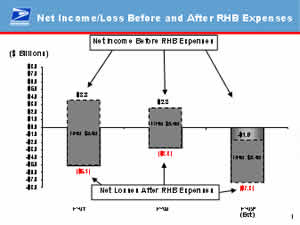
Graph 1
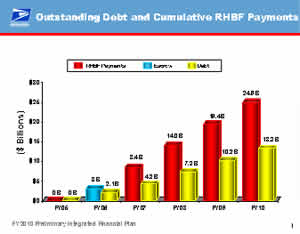
Graph 2
Viewed within the context of our current and future financial condition, continuation of the prefunding requirement at current levels is unsustainable. Your recent introduction of S. 1507, a bill to reform Postal Service retiree health benefits funding, would provide a sorely needed and extremely welcome level of financial relief over the next five years. By reducing total costs by $6.4 billion during this critical period, the solvency of the Postal Service would be enhanced considerably.
The overall goal of a financially sound Postal Service is a goal shared by both the Administration and the House of Representatives, where a similar bill has been cosponsored by 80 percent of its Members. I am extremely appreciative and encouraged by the quick action of the Senate Committee on Homeland Security and Governmental Affairs in moving this bill forward for consideration by the full Senate. The issues we are working to address are important. By making this legislation a priority, you have shown the American people that you support a strong and sound national postal system.
The Postal Service supports the amendments added to S. 1507, particularly the amendment directed at our arbitration process. Current law requires an arbitrator to consider “comparable pay” in his or her decision. The amendment included in S. 1507 simply balances that requirement by including a consideration of the Postal Service’s financial health. We are equally pleased with the acceleration of the Government Accountability Office’s report regarding the business model necessary for the Postal Service’s long-term future. This effort will serve as a gateway for a much needed, broader debate about the manner in which the Postal Service can continue to serve the American public.
While the details of the House and Senate bills vary, their intention does not: protecting affordable, quality, universal mail service for every American home and business. I am confident that the Senate, the House of Representatives, and the White House, working together toward this shared objective, can and will act expeditiously to help create a firmer financial foundation for the Postal Service. You can rely on my full cooperation, and the cooperation of the Board of Governors and the entire management team.
Mr. Chairman, as you have indicated, this bill is not a “silver bullet.” There is more that must be done as Congress, management, and our employees continue their work together. In an environment defined by annual multi-billion dollar losses for the foreseeable future, other actions will be necessary to completely bridge a reduced but still considerable distance between our income and our expenses.
Very recently, the Office of Inspector General of the United States Postal Service completed a self-initiated review of the estimates of the Postal Service’s liability for retiree health care benefits. The Office of Inspector General, an entity separate and apart from Postal Service management, worked with a respected private-sector actuarial group to assess the assumptions used by the Office of Personnel Management to determine our liability.
The review concluded that, if the Postal Service continues the payment schedule required by the Postal Accountability and Enhancement Act of 2006, we could overfund our retiree health-care liability by $13.2 billion by the end of Fiscal Year 2016. Adjusting for this potential overpayment, the Office of the Inspector General determined that reduced annual payments of $1.57 billion–rather than the current average of $5.6 billon per year–would satisfy the funding goal that was identified by the Office of Personnel Management for the Postal Service Retirement Health Benefits Fund.
The Office of Inspector General also found that this goal was based on assumptions regarding average health-care cost inflation over a ten year period. We believe a more accurate assessment of our obligation would be based on actual costs, which can differ widely from individual to individual.
The variables include the total costs associated with the health plan selected, from the literally hundreds available to eligible Postal Service retirees. On a fixed income in today’s difficult economy, retirees are more sensitive than ever to receiving quality care at the lowest price possible. Levels of usage also vary considerably based on the needs and preferences of different enrollees, strongly affecting costs. And with career employment now numbering about 630,000, a decline of 66,000 positions since 2006, funding goals that were established at that time, based on a workforce of almost 700,000, must be reexamined.
At the request of the Chairman Stephen Lynch, and Representatives Danny Davis and John McHugh of the House of Representatives Subcommittee with oversight responsibility for the Postal Service, this issue was analyzed by the independent Postal Regulatory Commission. The Commission found that both valuations–one from the Office of Personnel Management and the other from the Postal Service’s Office of Inspector General–were reasonable in meeting the different purposes for which they were designed. However, the Commission suggests an alternative calculation that produces a long-term liability that could result in lower payments than current law requires. We appreciate their input into this important discussion.
As I have noted previously, no other employer is faced with this type of prefunding obligation at the levels required of the Postal Service. The report of the Office of Inspector General noted that the public and private sector employers that were surveyed, which included some of the largest in the nation, are not required to prefund post-employment health-care benefits.
In fact, there is no general prefunding requirement for the Federal government as a whole. In addition, the primary genesis of the prefunding obligation was as a means to preserve the budget neutrality of the Postal Accountability and Enhancement Act.
Economic assumptions regarding the Postal Service’s long-term ability to meet this obligation–assumptions that were reasonable and justified when the Act was passed in 2006–have been completely eclipsed by an economy that has been shaken to its core. As we work to return the Postal Service to a sound financial footing, it is certainly appropriate to initiate a conversation regarding not simply the modification of the prefunding requirement, but its elimination.
Effectively surmounting our immediate and future financial challenges will require far more than a combination of cost management, product growth, and the elimination of staggering financial burdens. It will also require a basic structural change to our business in the form of reduced delivery frequency.
This is a difficult choice but, given the gravity of our financial situation, a necessary choice, and one we are pursuing only reluctantly. We can no longer afford the costs of six-day mail delivery.
In fiscal year 2000, our carriers delivered an average of 5.9 pieces of mail per day to every address they served. This year, that has fallen to 4.7 pieces–a decline of 20 percent. Over the same period, our delivery base has expanded by more than 11 million addresses. We are delivering less mail to more addresses, resulting in less revenue per address served. The ratio of higher-contribution First-Class Mail to lower-contribution Standard Mail has also declined steadily over a 10-year period further eroding revenue per delivery.
With the existing six-day delivery requirement, we simply do not have the ability to adequately adjust to the financial pressures this situation has created. However, under a five-day delivery model, the average number of pieces per daily delivery would return to the levels of 2000.
Reducing the frequency of delivery would be an important step in helping to close the gap between costs and revenue–a situation that is unachievable in today’s environment because of the requirement to maintain six-day delivery. In mail processing and retail operations, workhour reductions, which reflect volume variability, have essentially tracked mail-volume declines. But in delivery operations, because of their much-higher ratio of fixed costs, workhour reductions have been held to only half that rate, reflecting a structural issue that impedes our ability to align system capacity with a marked reduction in system use.
Providing the Postal Service with the ability to reduce delivery from six days to five is an effective and appropriate response to the sobering reality of our fiscal situation. By acting sooner rather than later, we can not only sharply reduce our losses but we can help restore profitability to our operations.
Independent surveys show that the majority of Americans would prefer five-day delivery to other options–such as a price increase, closing their local Post Office, or returning to a tax-subsidized Postal Service. According to a recent Gallup Poll on this subject, more than three out of four Americans said it was “very important” to them that the Postal Service remain in business.
Our customers have considered what is at risk and they have examined the options. They have said that they are willing to accept this change as a reasonable solution that accommodates their needs and the needs of the Postal Service.
Our experience over the last several years has provided us with a valuable perspective regarding the financial goals of the modern Postal Service. For the first 35 years since beginning operations in 1971, we were required to operate on a break-even basis. We met this requirement.
The enactment of the new Postal Law in 2006 made a fundamental change to this model. For the first time, we were permitted to plan and operate with the goal of generating positive net income. Provisions that permitted us to retain earnings and reinvest them in our business encouraged a new approach to planning, operational efficiency, and pricing, product, and marketing initiatives. Unfortunately, the effects of the economic recession, which began to be felt in 2007, only short months after the new law went into effect, had the practical result of deferring our ability to operate profitably.
Yet the years immediately preceding the recession were among the most successful we have ever experienced. Service performance continued to reach new heights. For the period from 2000 through 2007, productivity growth was five times greater than it had been during the previous 27 years. Mail volume was on a steady upswing, at or near a record 213 billion pieces from 2005 through 2007. Debt, which stood at $11.1 billion in 2002, was completely retired in 2005. Liquidity was not a concern.
The common thread that linked most of these achievements–both as cause and result–was our bottom-line financial results. Beginning in 2003, and in every subsequent year through 2006, the Postal Service was profitable, recording more than $9 billion in cumulative net income. As I have indicated, that would have continued in each of the two following years, and our loss for 2009 would have been significantly smaller, but for the effect of the prefunding requirement for retiree health benefits.
That is no longer the case. Productivity is showing a decline as mail volume falls and the number of delivery points continues to increase. We will soon reach our maximum borrowing limit of $15 billion. The prospects for servicing or retiring that debt are not encouraging in the foreseeable future. Annual multi-billion dollar losses will continue. We do not expect to be able to meet all of our cash obligations. While we anticipate that an eventual economic recovery will end the current declines in mail volume and result in renewed mail volume growth, we cannot predict the timing or strength of that recovery. And, considering the recession’s negative and disproportionate effect on some industries that were key generators of mail, we do not anticipate that volume will return to its former levels.
Our landscape has changed, unalterably. Our task is to take the actions necessary to make it possible for the Postal Service to continue to provide universal service to the nation, and to do so in a radically altered business environment. It is critical that our actions are sufficient for the Postal Service to close the gap between costs and revenue. Only by meeting this minimum requirement can we set the stage for business success.
But I believe we must do more. Simply breaking even will not allow us to pay down debt that will reach and remain at $15 billion. The most prudent path the Postal Service can take is to recognize that the loss of volume represents a new norm and to modify operations accordingly. Simply breaking even will not ensure the levels of liquidity that are needed and at the times they are needed. Simply breaking even will not allow us to make the investments in the technology, processes, equipment, and buildings that are necessary to maintain the United States Postal Service as the best and among the most affordable in the world.
Simply put, our goal must be more than breaking even. It must be to generate positive net income–profitability–year in and year out. Reinvesting that profit in our business by constantly improving our performance, our efficiency, and our financial foundation, will pay dividends for every postal stakeholder.
The American people have expressed their support for the Postal Service. We are honored and grateful for their confidence. We owe them our promise that their Postal Service will be an asset and not a liability or a burden.
Within the constraints of the current law, the Postal Service is taking a number of specific steps that will help us to deliver on that promise:
Our ultimate success requires that the steps we are taking be supplemented by specific legislative actions by Congress. We will continue to seek your support for:
The Postal Service is a vital and valued element of our nation’s communications infrastructure. It has served our country well for more than 234 years by adapting to the changing needs of a changing nation. It is a vastly different organization today than it was in the past. And it will be a vastly different organization in the future than it is today.
At key times of change, Congress, in representing the interests of the people of our nation, has acted to preserve affordable, universal mail service for everyone in America. I trust that you will take the steps necessary to help us continue this proud tradition. By holding this hearing today, you have expressed your firm support of that mission, a mission that was defined by Congress more than two centuries ago.
Mr. Chairman and members of the Subcommittee, I appreciate the opportunity to share my thoughts with you today. I appreciate your support of the Postal Service, its employees, and its customers. And, on behalf of everyone who relies on the United States Postal Service, I appreciate your efforts to strengthen America’s postal system. I would be pleased to answer any questions you may have.
# # # #