Skip Top Navigation
  • Who We Are

    • Leadership
    • Financials
    • Government Relations
    • Judicial Officer
    • Legal
    • Our History
    • Postal Facts
  • What We're Doing

    • Strategic Planning
    • Current Initiatives
    • Securing The Mail
    • Sustainability
    • Corporate Social Responsibility
    • Government Services
    • Postal Customer Council
    • Service Performance Results
  • Newsroom

    • National News
    • Local News
    • Testimony & Speeches
    • Broadcast Downloads
    • Events Calendar
    • Photo Gallery
    • Service Alerts
  • Careers

    • Career Opportunities
    • Working at USPS
    • How to Apply
    • Profile Login
  • Doing Business with Us

    • Suppliers
    • Licensing
    • Rights & Permissions
    • Auctions
    • Public Key Infrastructure
The image is the profile of an eagle's head adjoining the words United States Postal Service to form the corporate signature, along with the text About
Link to "2-5.1 Importance of Value Chain Mapping and Analysis" Link to contents for "2 USPS Supplying Practices Process Step 2: Evaluate Sources"      Link to "2-5.3 Activity Based Costing"

2-5.2 Constructing a Value Chain Map

The Postal Service can create a value chain map by interviewing key individuals within each product category to construct a detailed representation of all steps involved in the process or flow of a product or service, from raw material/creation to end-user consumption/use. Current costs are then baselined, using ABC to identify the cost pools, or activity centers, in an organization. Costs are assigned to products and services based on the number of events or transactions involved in the process of providing a product or service. ABC helps managers determine which steps of a particular process are creating or eliminating value. This is similar to process flowcharts; the only difference is that each step is then categorized into three types of work.

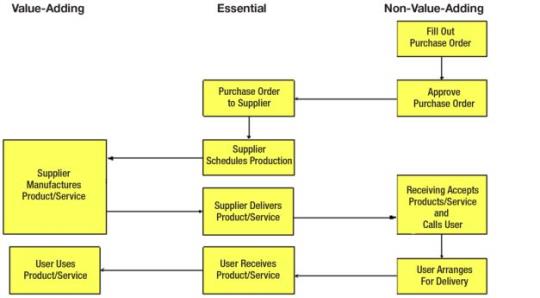
Figure 2.4 shows ten steps in a typical purchase process. Of these ten steps, two are value-adding, four are essential, and four are non-value-adding.

  • Value-adding — tasks or work steps directly required to create the product or service.
  • Essential — tasks or work steps necessary to support a function, but in and of themselves adding no direct value to the finished product or service.
  • Non-value-adding — tasks or work steps neither necessary nor required to meet cost or quality standards for a given product or service.

Figure 2.4

Example of a Value Chain Map

Figure 2.4 Example of a Value Chain Map


Link to "2-5.1 Importance of Value Chain Mapping and Analysis" Link to contents for "2 USPS Supplying Practices Process Step 2: Evaluate Sources"      Link to "2-5.3 Activity Based Costing"
  • LEGAL

    • Privacy Policy ›
    • Terms of Use ›
    • FOIA ›
    • No FEAR Act EEO Data ›
  • ON ABOUT.USPS.COM

    • Newsroom ›
    • USPS Service Alerts ›
    • Forms & Publications ›
    • Careers ›
    • Site Index ›
  • ON USPS.COM

    • USPS.com Home ›
    • Buy Stamps & Shop ›
    • Print a Label with Postage ›
    • Customer Service ›
    • Delivering Solutions to the Last Mile ›
  • OTHER USPS SITES

    • Business Customer Gateway ›
    • Postal Inspectors ›
    • Inspector General ›
    • Postal Explorer ›
Copyright© 2025 USPS. All Rights Reserved.