
Oct. 31, 2023
U.S. Postal Service and Juneteenth of Fairfield County to Honor Civil Rights Icon Chief Standing Bear in Local Stamp Ceremony
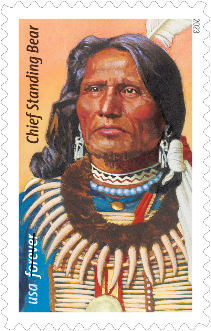
What:
-
The Postal Service, alongside the Juneteenth of Fairfield County Inc., will host a ceremony to honor the Chief Standing Bear Forever Stamp.
The event will include an unveiling of the stamp, guest speakers and special guests.
The Postal Service issued the Chief Standing Bear Forever stamp in May 2023, honoring the Native American civil rights icon, who won a landmark court ruling in 1879 that determined a Native American was a person under the law with an inherent right to life, liberty, and the pursuit of happiness.
-
Who:
-
Bridgeport Postal Service leadership, Bridgeport Postal Service Supervisor Customer Service Emma Lawson, Juneteenth of Fairfield County Inc., guest speakers and residents.
-
When:
-
Saturday, Nov. 18, 2023
11 a.m. -
Where:
-
Post Office Square Park
Bridgeport, CT. -
Background:
-
Chief Standing Bear (circa 1829–1908) was a member of the Ponca tribe, who lived in the Niobrara River Valley in what is now northeastern Nebraska.
The tribe's traditional homeland was included in the Great Sioux Reservation established by the Fort Laramie Treaty of 1868. The federal government later decided to resolve conflicts between the Sioux and the much smaller Ponca tribe by relocating the latter to the Indian Territory in what is now Oklahoma.
The U.S. Army’s forced removal of some 700 Ponca began in the spring of 1877.
Some members of the tribe died during the 600-mile journey by foot. More than a hundred others, including Standing Bear’s only son, died from disease and hunger shortly after the removal to the Indian Territory.
Wanting to honor his son’s dying request to be buried in the tribe’s Niobrara homeland, Chief Standing Bear and a small band of some 29 other like-minded Ponca made the arduous trip back to Nebraska in 1879.
They were arrested by the Army and imprisoned at Fort Omaha.
After attracting the sympathy of a newspaper reporter and the Army general who arrested him, Standing Bear sued the federal government for his freedom.
Lawyers filed for a writ of habeas corpus on his behalf to test the legality of his detention, the first time in U.S. history such a filing had been made on behalf of a Native American.
In the closely-watched court case, Standing Bear v. Crook, Judge Elmer Dundy ruled on May 12, 1879, that an Indian was a person under the common understanding of the word and that all persons in the United States, regardless of race, had an inherent right to life, liberty, and the pursuit of happiness. The judge ordered that Standing Bear and his fellow Ponca be released from custody.
# # #
MEDIA ADVISORY
Media contacts
-
Amy Gibbs
amy.n.gibbs@usps.gov
(347) 668-6709