
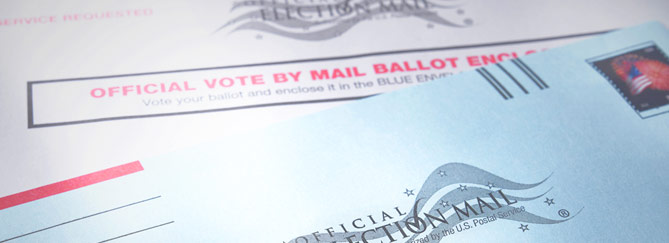
The Postal Service provides a secure, efficient and effective way for citizens to participate when policymakers choose to use the mail as part of their election systems or when voters choose to use our services to participate in an election. The Postal Service has a robust and tested process for proper handling and timely delivery of Election Mail. Every federal election cycle, we make efforts across the nation to inform local and state election officials about mailing procedures, our operational standards, and our recommended best practices for utilizing the mail.

Election Mail
Introduction
The American public can rely on the United States Postal Service’s over 640,000 employees to deliver the nation’s Election Mail.
Continue for

Postmarks: If you want to ensure that your mail receives a postmark on the day you mail it, ask a retail associate at a Post Office retail counter to hand-cancel it for free. Learn more
What is Election Mail?
It’s any item mailed to or from authorized election officials that enables citizens to participate in the voting process — including ballots, sample ballots, voter registration cards, absentee voting applications and polling place notifications. Ballot Mail is a subset of Election Mail. It consists of any mailpiece sent to or from an authorized election official containing a live ballot that may be used to cast a vote in an election. Election Mail should not be confused with Political Mail, which is any material mailed for campaign purposes by a registered political candidate, campaign committee or committee of a political party, as well as any material mailed by a political action committee or organization engaging in issues advocacy or voter mobilization.
Look for the Official Election Mail logo!
The Official Election Mail logo is a unique registered trademark designed exclusively for inclusion in the design of official Election Mail. Election officials are not required to use the logo, but the logo does appear on most Election Mail. When the Official Election Mail logo appears on a mailpiece, voters recognize the mail as important and distinct from partisan political mailings. Additionally, the logo serves to identify official Election Mail for Postal Service™ workers and distinguishes it from the millions of other mailpieces that are processed daily.
The Official Election Mail logo should be used on any mailpiece created by an election official that is mailed to or from a citizen of the United States for the purpose of enabling participation in the voting process. This includes ballots, sample ballots, voter registration cards, absentee applications, polling place notifications. The logo should be used on all classes of mail and all processing categories.
We protect your mail

The United States Postal Inspection Service is responsible for ensuring the safety of all mail, including Election Mail. Please visit the Postal Inspection Service website for more information relating to Election Mail security. To report law enforcement matters relating to Election Mail and for general information about the Inspection Service please visit www.uspis.gov.
Voters
If you choose to vote by mail, we encourage you to explore resources available from your state and local election authorities. They can provide information about processes, rules, deadlines and policies specific to your state. USPS® guidance and recommendations on how to successfully use the mail can be found below.
Learn about voting in your area
Find your state election website
For all other USPS customer support issues, including mail and package tracking, customer service contacts and technical support, please visit USPS customer support.
Need more voter information?
FAQs for domestic, nonmilitary voters
It’s important to understand your local jurisdiction’s rules and requirements for participating in an election. If you are eligible to vote by mail and choose to do so, you should plan ahead to give yourself enough time to receive and then complete and return your ballot by your state’s deadlines.
If you are a nonmilitary voter located in the United States and you choose to use the mail to return your completed ballot, our general recommendation is that, as a common-sense measure, you mail your completed ballot before Election Day, and at least one week prior to the deadline by which your completed ballot must be received by your election office.
Some states may recommend allowing even more time for mailing completed ballots. In addition, some states require all ballots (including mail-in ballots) to be received by the election office by a specified deadline, while other states may accept ballots received after that deadline as timely if they were mailed and postmarked by a specific date. You should always check to make sure you understand your state’s requirements and recommendations on mailing your completed ballot. You can look for information about your state’s requirements and recommendations here: Find your state election website.
Some jurisdictions automatically mail ballots to all eligible voters. In jurisdictions that require eligible voters to request a ballot in order to receive one through the mail, we recommend that domestic, nonmilitary voters request their ballot as early as their jurisdiction allows.
Mailpieces containing a completed ballot are handled as First-Class Mail® service, regardless of whether they are prepaid by election officials or mailed with a stamp affixed by the voter. The only situation where a completed ballot is not handled as First-Class Mail is when the voter opts to pay for a premium service like Priority Mail® service or Priority Mail Express® service.
Unless your state or local election officials provide you with a prepaid return envelope, you should make sure appropriate postage is affixed to your return ballot envelope. To help voters, the Postal Service requires election officials to inform voters of the amount of First-Class postage required to return their ballots, if the voter decides to return their completed ballot by mail.
The Postal Service tries to ensure that every piece of Ballot Mail returned by voters receives a postmark, regardless of whether it is mailed with postage prepaid by election officials or mailed with a stamp affixed by the voter.
If voters want to ensure that their completed ballot-return envelope receives a postmark, and that the postmark date aligns with the date of mailing, they should bring their mailpiece to the retail counter at a Postal Service retail location and request a manual postmark, which will be applied free of charge upon accepting custody of the mailpiece.
Learn more about postmarking.
The Postal Service recognizes that Election Mail, and Ballot Mail in particular, is time-sensitive. We are committed to the expeditious processing and delivery of Ballot Mail. However, to minimize the risk that Ballot Mail will not arrive before your state’s deadline, we recommend as a best practice that voters act early if they plan to use the mail to return their completed ballot.
Military and overseas voters
The mail is an important vehicle to enable U.S. military members and citizens who live abroad to vote in elections.
Here’s what you need to know
- Ballot Mail needs extra time and special tags for addresses at Army and Air Force Post Offices (APOs), Fleet Post Offices (FPOs) and Diplomatic Post Offices (DPOs). Ballot Mail from other international addresses will need extra time as well and need to consider longer international mailing times.
- In jurisdictions that require eligible voters to request a ballot in order to receive one through the mail, we recommend eligible voters who live abroad should request a ballot as early as their jurisdiction allows.
-
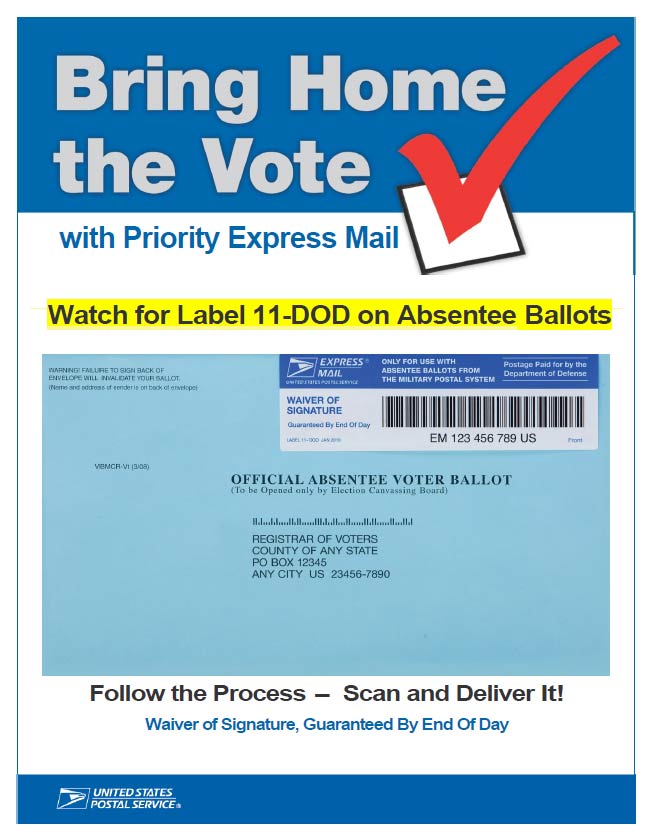 Uniformed services voters who are overseas with
authorized APO/FPO/DPO addresses may be able to return
absentee ballots using Priority Mail Express service
with Label 11-DOD,
DOD Express Mail Label Absentee Ballot. The label
includes “Waiver of Signature” and “Guaranteed by End of
Day” endorsements so Ballot Mail can be delivered the
day they arrive at the destination Post Office
facility.
Uniformed services voters who are overseas with
authorized APO/FPO/DPO addresses may be able to return
absentee ballots using Priority Mail Express service
with Label 11-DOD,
DOD Express Mail Label Absentee Ballot. The label
includes “Waiver of Signature” and “Guaranteed by End of
Day” endorsements so Ballot Mail can be delivered the
day they arrive at the destination Post Office
facility.
- The Military Postal Service Agency distributes Label 11-DOD overseas and covers postage.
- Label 11-DOD may be used only by absent overseas uniformed services voters, as defined by the Uniformed and Overseas Citizens Absentee Voting Act, for Ballot Mail returned at authorized APO/FPO/DPO locations in qualifying elections.
- Label 11-DOD may be used on any size return Ballot Mail envelope. It always goes in the upper right corner of the Ballot Mail envelope.
- Voters can keep part of the tracking label to use the tracking number to track their Ballot Mail.
For more information:
- Your local election official is a good source of additional information and can help answer your questions.
- Overseas voters who are not affiliated with the U.S. military or overseas offices of the U.S. government can find more information here: Department of State
- Refer to “Special Procedures APO/FPO/DPO and Overseas Citizens Absentee Ballots” in the USPS Election Mail Kit
- Postal Explorer® Guidelines for APO and FPO Mailing
- Federal Voting Assistance Program
We also recognize that voters have options other than the mail for participating in the electoral process. To ensure that individuals who wish to use the mail to vote can do so successfully, election officials and voters should keep in mind the time required for both legs of a completed ballot’s delivery through the mail — to the voter and back to election offices.
Election Mail and Ballot Mail sent to or from an authorized election official should bear the Official Election Mail logo and Intelligent Mail® barcode.
For more details, download: Publication 631: Official Election Mail – Graphic Guidelines and Logos
USPS Mailpiece Design Analysts (MDAs) are specially trained USPS employees who can answer questions about mailpiece design, give advice on evaluating pieces of mail for automation discounts, provide technical assistance on envelope standards, and help construct mailing plans. See below to request a design review by an MDA.
For assistance from an MDA call 877-672-0007 (select option 2 for mailing and shipping, then option 2 for MDA). Hours of operation are Monday through Friday, 7 a.m. to 7 p.m. Central Time (closed federal holidays).
The Postal Service recommends using green Tag 191, Domestic and International Ballots, unique three-digit codes known as Service Type IDentifiers (STIDs), and serialized Intelligent Mail® barcodes (IMb®) to identify Ballot Mail within the postal network.
In addition, election offices should include the Official Election Mail logo (a registered trademark designed exclusively for Election Mail) on envelopes and check the Election Mail boxes at induction to help improve the visibility of Election Mail and Ballot Mail in the mail stream.
These identifiers have increased the visibility of outbound and return Election Mail within the automation environment.
Some state and local election officials have expressed interest in expanding the use of prepaid reply mail so voters don’t have to pay for postage when returning their ballots by mail. The Postal Service has a number of solutions available to assist election officials with prepaid reply mail.
If a prepaid return envelope is not used, appropriate postage should be affixed to the return Ballot Mail envelope. To help voters, the Postal Service requires election officials to inform voters of the amount of First-Class postage required to return their Ballot Mail.
USPS contact forms for Election Officials
The Postal Service can assist local and state election officials with any of their Election Mail needs.
Election Mail design review
Mailpiece Design Analysts (MDAs) are specially trained postal employees who evaluate mailpiece design, automation discount opportunities, envelope standards, and more.
Contact a Local Manager, Customer Relations
Local Managers, Customer Relations serve as primary points of contact to guide election officials through the mailing process and match postal services with their needs.
Report a problem
Election officials can receive support by notifying the Postal Service of any Election Mail service issues.
For further Election Mail assistance, call 877-672-0007 (select option 2 for mailing requirements or option 3 for mailpiece design). Hours of operation are Monday through Friday, 7 a.m. to 7 p.m. Central Time (closed federal holidays).
FAQs for Election Officials
Two common causes of Election Mail issues are poorly designed mailpieces and state laws or other binding directives that do not build in enough time to account for mail delivery timeframes for time-sensitive Election Mail that is sent to and returned by voters using the mail. To ensure that individuals who wish to use the mail to vote can do so successfully, election officials and voters should keep in mind the time required for both legs of a ballot’s delivery through the mail — to the voter and back to election offices.
Yes, it can be applied to most Election Mail and the Postal Service strongly recommends its use by election officials. This barcode is used to sort and track individual pieces of mail and gain greater visibility into the flow of the mail. It allows mailers, in this case, election officials, to participate in multiple USPS programs simultaneously, expand their ability to track individual pieces of mail, and see where ballots are within the mailstream. Refer to the Election Mail kit for more information.
The Postal Service recommends that election officials include the Official Election Mail logo on their Election Mail, but use of the logo is not required. The Official Election Mail logo should be used on any mailpiece created by an election official that is mailed to or from a citizen of the United States for the purpose of participating in the voting process.
When the Official Election Mail logo appears on a mailpiece, voters recognize the mail as important and as distinct from partisan political mailings. Additionally, the logo serves to identify official Election Mail for Postal Service workers and distinguishes it from the millions of other mailpieces that are processed daily.
Since this logo is a registered trademark, it is important for election officials to:
- Read and comply with the requirements for its use. For more details, download: Publication 631: Official Election Mail – Graphic Guidelines and Logos
- Request a design review with an MDA via online form or by calling 877-672-0007 (select option 2 for mailing and shipping, then option 2 for MDA). Hours of operation are Monday through Friday, 7 a.m. to 7 p.m. Central Time (closed federal holidays).
The Postal Service generally recommends that domestic, nonmilitary voters who choose to return their completed ballots by mail do so before Election Day, and at least one week prior to the deadline by which their completed ballot must be received by their election office. Some states may recommend allowing even more time for mailing completed ballots. Voters need to understand their jurisdiction’s requirements and recommendations, and we provide them with the following link to help: Find your state election website. It’s also recommended that overseas voters return their ballots using a level of service that, based on the information available, should result in the ballot being received by the applicable state deadline. We strongly advise election officials to factor into their planned mailings the time it will take to both send and receive Election Mail.
The Postal Service can use localized continuity of operations plans in case of emergencies to help ensure that the USPS system continues to function for the American people. With a longstanding history of quickly adapting operational plans to changing conditions, the Postal Service maintains steady communications with mailers during natural disasters or other events that require emergency responses. We keep residential customers and business mailers updated on facility service disruptions on the USPS service alerts page.
Guidance documents & resources for Election Officials
Kit 600 supplementals
Guidance documents
- Facilitating return ballots using prepaid postage
- Mail security flyer
- Military absentee ballots FAQs
Additional resources
- Election Mail webinar, Oct. 15 (Passcode: Z3#2Lt!r)
- Absentee balloting materials, DMM® 703.8.0
- General Election Mail Preparedness Memorandum
- USPS Service Standards
- 2026 Postal Bulletin: Election and Political Mail Guide
- 2026 General Election Extraordinary Measures Memorandum
- 2026 Guidance on Postmarking Ballots Memorandum