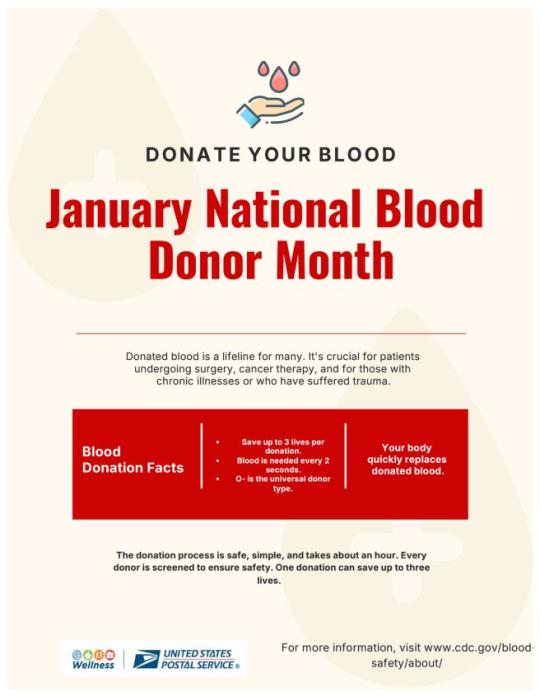
Every 2 seconds, someone in the United States needs blood, and a single donation can save lives. Blood donors are true heroes. Why is blood so important? Blood helps deliver oxygen and nutrients to cells while moving waste to the liver and kidneys. This process keeps us alive.
Healthy adults have about 5-6 liters of blood circulating throughout their body. Each drop contains red blood cells, white blood cells, platelets, and plasma.
Patients may need blood to address the following:
n Heavy bleeding,
n Surgery,
n Trauma,
n Organ transplant,
n Cancer and treatment,
n Infectious diseases,
n Blood diseases, and
n Gastrointestinal diseases.
Donating is important because blood has a short shelf life and there is a constant need. For example, platelets can be stored for only 5-7 days. Red blood cells can be stored for only up to 42 days.
Most people can donate blood. Donors should be in good health, at least 16 or 17 years old (depending on the state they live in), and weigh at least 110 pounds. They must also have healthy levels of hemoglobin, which is a protein that carries oxygen in the blood.
Only 3 percent of Americans give blood each year. If you are healthy and eligible, please consider donating regularly, because blood is always needed.
For more information about donating blood, go to the National Heart, Lung and Blood Institute’s blood donation webpage at nhlbi.nih.gov/education/blood/donation.
Benefits and Wellness,
Human Resources, 1-22-26