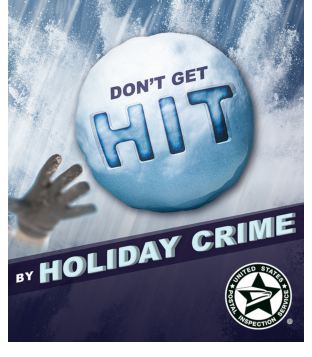
The holiday season is about spending time with people we love, giving gifts, and spreading cheer. But while you’re busy checking items off your holiday to-do list, scammers are busy looking for ways to take advantage of your giving spirit. They’ll call, email, text, or use social media, pretending to be someone or something they are not. And they’ll steal your joy right along with your hard-earned money and mail.
Don’t get hit by holiday crime. Keep your eyes open for the following red flags to protect holiday cheer for you and your loved ones:
n Unsolicited offers: Many scammers send offers by mail, text, or will call with slick wording or an urgent request to spike your interest in what seems like a great deal. But it’s not. Most offers are not worth the time they took to create. Simply delete it, don’t answer the phone, or trash it.
n Bogus charities: Many people give to those less fortunate during the holidays. But scammers also choose this time of year to take advantage of your generosity. Watch out for supposed charitable organizations whose names seem very similar to real ones but may be off by a letter or word. Verify the authenticity of the charity on sites like Charity Navigator or the Better Business Bureau before sending money. And never donate cash. Make checks payable to the organization, never an individual.
n The “-ishing” imposters: These holiday party crashers may show up as your bank asking for your account information or Social Security number to verify a transaction, or as the Postal Service™ asking for personal information because your package can’t be delivered, or even as Santa himself with an unexpected gift and QR code attached to see who generously sent you the gift. These are all types of phishing, smishing, and quishing schemes. Regardless of who they appear to be, these naughty little “-ishers” want to trick you into clicking on a link, scanning a QR code, or providing information to someone pretending to be someone they are not. Don’t fall for it; the imposters could steal your personally identifiable information, and when they do that, they’ll steal your money next.
n Fake stamps: Get an offer for stamps at a huge discount? They’re most likely counterfeit. Buy your stamps at your Post Office™ or from approved Postal Service providers, which include legitimate “big box” retailers.
n Beware of mail and package thieves: Thieves are also getting ready for the busy holiday season, just like you! Your packages may arrive on time but may not truly reach their intended recipient if they‘re plucked from the porch before you or your loved ones can get them inside.
Here are some helpful tips to keep your holiday packages safe:
n Don’t leave letters and packages in your mailbox or at your door for any length of time. Use USPS Hold Mail service, a delivery locker, or ask a trusted neighbor to grab your package if you are going to be away.
n Request signature confirmation on packages, and add package tracking.
n Sign up for Informed Delivery at usps.com/manage/informed-delivery.htm so you know what mail and packages to expect and can keep an eye out for their arrival.
n If you move, file a change of address with USPS® at usps.com, and let your financial institutions know as soon as possible.
If you suspect you, someone you know, or a Postal Service customer may be a victim of any of these scams or of mail or package theft, report it online at uspis.gov/report or via phone at 877-876-2455.
For more information on how the U.S. Postal Inspection Service protects employees and customers, go to the “Project Safe Delivery” page at uspis.gov/psd. And for more fraud prevention tips, go to the “Tips and Prevention” page at uspis.gov/tips-prevention.
Let this holiday season be filled with the joy of festivities and sharing with the ones you love, not with the frustration of getting hit by holiday scams or stolen packages.
— Communications, Governance, and Strategy,
U.S. Postal Inspection Service, 11-26-26



