Secure Your Dog, Keep Deliveries on Track (#dogbiteawareness)
Sponsored by the United States Postal Service®, the National Dog Bite Awareness Campaign is a public service campaign that offers safety tips and emphasizes the need for increased owner responsibility in the prevention of dog attacks.
The Postal Service™ reports that dog attacks are the most prominent threat to carriers. Last year, over 6,000 Postal Service employees were attacked by dogs while simply doing their job. This is why we are asking you to restrain your dog when your carrier is in the area or delivering your mail.
Many of us are dog lovers, but few of us are dog experts. Even dogs that have never shown signs of aggression can react in ways their owners don’t expect. Their instinct to protect their owners and their owners’ property can be triggered without warning. Dogs may attack not only to defend their territory, but also when they feel startled, anxious, unwell, or if they are guarding food or toys. It’s not just about bad or aggressive dogs — it’s about unpredictable moments.
Keep your dog in a separate room or area away from the door when the mail carrier comes to your house. If you go outside, close the door firmly behind you and make sure it is secured, so your dog doesn’t slip out or unexpectedly bust through it. If you are outside with your dog while mail is being delivered, make sure your dog is secured away from the mail carrier and on a leash. Never accept the mail from your mail carrier in the presence of your dog.
The tools available in this kit and online help promote awareness of this important public health concern to reduce the number of injuries with our mail carriers while delivering the mail. Be sure to contact the field communications professionals listed in this kit for assistance when promoting this initiative to the public.
Dog Bite Awareness Background and Tips
n Mail carriers being bitten or chased by dogs is a real problem. It only takes one wrong interaction or movement for our carriers to be injured.
n Don’t run away or past a dog. The dog’s natural instinct is to chase people who run.
n If a dog threatens you, don’t scream. Avoid direct eye contact but pay attention to the dog. Try to remain still until the dog leaves, and then back away slowly until the dog is out of sight.
n Always respect a dog’s space. Never assume it’s safe to approach, even if the dog seems calm or familiar.
n If a dog is about to attack, try to place something between yourself and the dog, such as a satchel, backpack, or bicycle.
n Obedience training can teach dogs proper behavior and help owners control their dog in any situation.
n When a mail carrier comes to the home, keep dogs:
n Inside the house or behind a fence and away from the mail carrier.
n Away from the door.
n In another room.
n On a leash.
n Dogs can be protective of their territory and may interpret the actions of mail carriers as a threat.
n Pet owners should remind children not to take mail directly from a mail carrier as the dog may view the carrier as a threat to a child.
Postmaster Publicity Kit 2025
The theme is “Secure Your Dog, Keep Deliveries on Track.”
USPS National Dog Bite Awareness Campaign, June 1–30, 2025
n Information for all Mail Carriers
n Sample/Matte Release
n Letter to the Editor
n General Letters to Customers (English and Spanish)
n Public Service Announcements
n Social Media
n Tease
n Tweets
n Postmaster Outreach Speech to Students
n Coloring Page for Students
n Glossary
n Area Corporate Communications Managers
n Government Relations Representatives
n 2024 Dog Attack Rankings by City
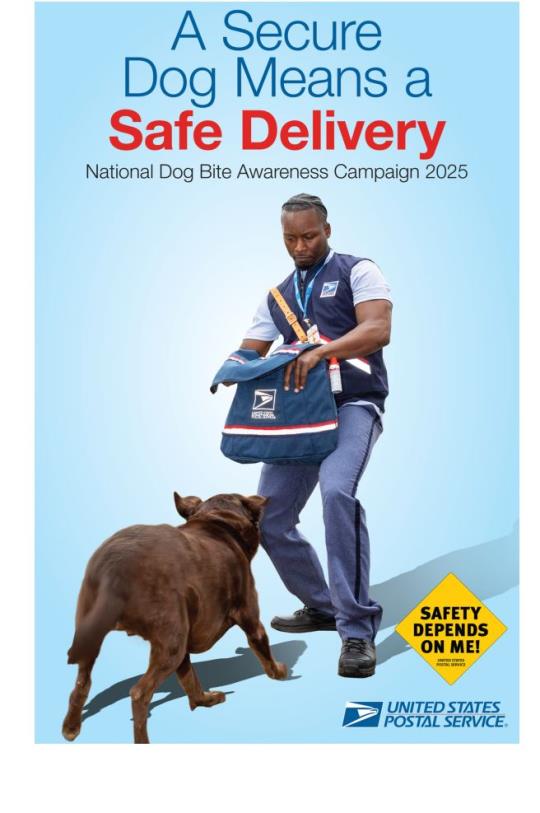
Information for All Mail Carriers
Protect yourself by doing the following every day:
1. Carry dog repellent.
2. Update dog warning cards and route hazards, if necessary. The safety of your coworkers and anyone on the route starts with you.
3. Take messages on your Mobile Delivery Device (MDD) seriously when you receive an alert about hazards, such as dogs, on your route. Familiar doesn’t mean safe.
4. Report any dog incidents on your route (e.g., close calls) to your supervisor. An “almost bite” today could be a “bite” tomorrow.
Remember these simple rules:
1. If approached by a dog, resist the impulse to scream and run away. Running will trigger a chase response.
2. Remain still, place your satchel between you and the dog, and avoid eye contact with the dog but pay attention to them.
3. Once the dog has calmed down, back away. Do not turn your back on a dog because a fearful dog may unexpectedly bite.
Be aware of your surroundings to protect yourself:
1. Stay alert at all times:
a. Observe the area carefully.
b. Don’t wear earbuds or Bluetooth devices that could affect your ability to hear what is going on around you.
c. Be aware of common places dogs may hide (e.g., under parked cars, under hedges, or on porches).
d. Rattle the gate before entering a fenced-in yard.
e. Place your foot against an outward swinging door when making a delivery to a customer at the door.
f. Refrain from handing mail to a customer or child if a dog is present. This gesture and movement could be interpreted as a threat to their owner.
2. If you encounter a dog:
a. Never assume that a dog won’t bite, even if it has been friendly in the past. Any dog can bite.
b. Always keep your eye on the dog. Dogs are more likely to bite when you aren’t looking.
c. Never startle a dog. If it is asleep, make some kind of non-startling noise, such as a soft whistling, or call its name if you know the dog. Do this before getting close to the dog to ensure time and space for an “out.” Never reach out and pet the dog.
d. Stand your ground. Turn and face the dog. Hold something in front of you, like your satchel, and back away slowly to ensure you don’t stumble and fall. Never turn and run!
e. Always keep at least one full can of dog repellent spray within reach. If a dog attacks, use the repellent to protect yourself. Before going on your route, make sure your can has not expired.
3. Use these preventative measures:
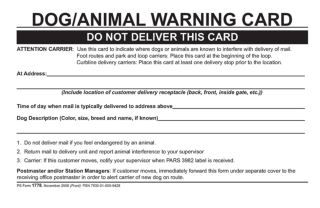
a. No one likes surprises. Fill out a Dog Warning Card for each dog on your route. Inform your supervisor about dog hazards on your route so the information can be entered into the RIMS system and sent via MDD.
b. Notify your supervisor when there is an unresolved dog hazard that makes you fearful on the route.
Information for Postal Managers
This section offers materials for postmasters and supervisors to help carriers safely perform their jobs. Use the progressive warning letters to alert dog owners to the possible loss of mail delivery if they do not restrain their pets. Also, don’t forget to send a letter of thanks when they do!
Warning letters, like collection letters, need to be handled tactfully. In MyHR, under the Dog Bite section in Workplace Safety, the first two sample letters explain to customers what to do. The third tells them the Postal Service has taken corrective steps. The fourth and fifth letters detail customer options. Keep in mind that the purpose is not to police the neighborhood, but to ensure a safe environment for carriers to do their work. Though most customers will respond to the first polite request, be sure to follow up if they don’t. Management in delivery offices can help drive down dog bites by taking these actions:
n Verify that dog warning cards are placed in carrier cases for addresses with known dogs.
n Enter dog warnings into the Regional Intelligent Mail Server.
n Verify that carriers have dog spray and satchels at all times.
n Train carriers how to react to dog attacks using service talks and videos from Safety resources.
n Provide sample dog letters for customers, dog bite prevention talks, and safety videos. These and other resources are available in the Safety Health Management Tool (SHMT) and in MyHR/Workplace Safety/ Prevention/Dog Bite.
Collection and delivery service personnel must report the name and address of the customer where animal interference occurs to the postmaster or authorized supervisor, who must immediately telephone the customer and request that the animal is confined during the usual neighborhood delivery hours. The postmaster or authorized supervisor must further inform the customer that:
n No deliveries will be made until this is done; and
n Service will be restored once assurance has been given that the animal will be confined during regular delivery hours.
It is the owner’s responsibility to control his or her dog. Most communities have ordinances for the control of dogs. Though postmasters and authorized supervisors frequently request that customers control their dogs or face discontinued service, attacks and injuries still occur.
In addition to this kit and online materials, a number of resources are available to help educate employees, customers, and the entire community about the importance of dog bite prevention. While the Humane World For Animals is not an official partner of USPS during this year’s National Dog Bite Awareness campaign, they are always willing to help organizations that promote safety around animals.
Remember: Safety Depends on You!

FOR IMMEDIATE RELEASE Name of PR Rep@usps.gov
[Insert Date] xxx.xxx.xxxx
Mobile: xxx.xxx.xxxx
usps.com/news

Four Tips for Preventing Dog Attacks on Mail Carriers
Can you picture a member of your family attacking a mail carrier? Of course not, but it happened over 6,000 times last year across the nation.
“I was bit by a dog on my leg recently and my mail satchel helped protect me,” said Francisco Juarez, a letter carrier who delivers in Houston, TX. “The sound of a dog barking while on my route puts me on high alert and I try to be ready to protect myself.”
Juarez recognizes the importance of the safety training he’s received as a letter carrier to help protect himself from dog attacks while delivering the mail. Even though he diligently follows dog bite safety protocols while on his route, he was still attacked by a dog.
When a dog attacks a letter carrier, the dog owner could be held liable for all medical expenses, repayment of lost work hours, replacement of the uniform and other costs, which can run into thousands of dollars. The Postal Service makes the safety of its employees a top priority and dedicates time each year on Dog Bite Awareness.
Here are four simple tips to prevent dog bite injuries year-round:
Door Delivery: If a carrier delivers mail or packages to your front door, place your dog in a separate room and close that door before opening the front door. Some dogs push through screen doors or plate-glass windows to attack visitors. Dog owners must keep the family pet secured. Never let your child take mail directly from carriers in the presence of the family pet, as the dog may see this as a threatening gesture.
Restrain Your Dog: Carriers may assume that if they see no physical fence around a property that the property is animal-free. This can be a dangerous mistake. Postal Service officials request that you keep your dog restrained or inside when the mail is delivered. Although the electronic fence may keep your dog from wandering, it does not protect your carrier, who must enter your property to deliver the mail. Even homes with curbside mailboxes may have oversized packages or signature-needed items that require the carrier to approach a doorstep and cross the boundaries of the electronic fence. This poses a serious risk to carrier safety.
Dog in the Yard: Make sure your dog is properly restrained on a leash and away from where your mail carrier delivers the mail. If the carrier deems a residence unsafe because of an unrestrained dog, mail delivery service can be interrupted. When service is interrupted at an address or in a neighborhood, all parties involved will have to pick up mail at their local Post Office. Service will be restored once assurance has been given that the animal will be confined during regular delivery hours.
Tracking: Dog owners who have access to postal notification features, such as Informed Delivery (informeddelivery.usps.com) for letter mail and package tracking, are urged to use these features to determine when the carrier is on their way and to ensure their dog has been properly restrained. Expecting a postal package delivery on Sunday? Postal officials urge dog owners to restrain their animals on Sundays as well, since more residences now receive deliveries throughout the weekend.
# # #

Publication Name
Street Address
City, State and ZIP Code
Dear Editor,
Did anyone bite you at work today?
On average, 16 mail carriers per day will say, “Yes.”
Postal Service officials report that in 2024, over 6,000 mail carriers experienced dog bites or dog attacks while just trying to do their jobs. With deliveries every day, including Sundays and holidays, carriers are on the move — and dog bites continue to affect them in all kinds of communities, from busy city streets to suburban driveways and quiet rural roads.
Dog attacks and bites are 100 percent preventable when dog owners remain vigilant and properly restrain their dogs.
To ensure mail carriers’ safety, dog owners must securely lock their dog in another room until a delivery exchange is done. If a dog is outside, the dog must be leashed away from the mailbox or doorstep as sometimes packages or certified mail require hand delivery all the way to your door. Make sure that moment doesn’t come with risk of injury.
When a carrier feels unsafe, mail service could be stopped, not only for the dog owner, but for the entire neighborhood if the dog is roaming the area. When mail service is stopped, mail must be picked up at the Post Office. Delivery service will not be restored until the dog is properly restrained and the area is deemed safe by the mail carrier.
With your help, we can keep our carriers, your neighbors and your dogs safe. Thank you for protecting your pet and our mail carriers as we continue to bring packages and other important correspondence to your door each day.
Sincerely,
[Name]
Postmaster
Safety Ambassador/Union Steward
[City]
# # #
Expressing Concern (English)
Dear Postal Customer:
Your letter carrier takes pride in delivering your mail promptly and efficiently. That means being able to approach your mailbox without interference from your dog.
Although your dog may not be known to bite or otherwise be dangerous to people, your carrier has expressed concern about its behavior. I believe you will agree this concern is understandable, since thousands of letter carriers get bitten or attacked by dogs each year. Many of these attacks result in serious injury.
This letter is to inform you that we are concerned your dog may have a tendency to attack, bite, or otherwise injure your Postal Service carrier.
To provide you with uninterrupted mail delivery while protecting our carriers, the Postal Service is requesting your assistance. Please confine your dog, either in the house or tethered or fenced outdoors, away from the route your carrier uses to deliver your mail.
We appreciate your cooperation.
Expressing Concern (Spanish)
Apreciado Cliente Postal:
Su cartero se siente muy orgulloso de darle un servicio de entrega diario, con mucha rapidez y eficacia. Eso significa el tener un acceso sin interferencia de su mascota cuando su cartero se dirige hacia su buzón de correspondencia.
A pesar de que se desconoce si su perro(a) halla mordido a alguien o que represente peligro a otras personas, su cartero ha expresado una preocupación debido al comportamiento de su perro(a). Pensamos que usted entenderá esta preocupación ya que cada año miles de carteros han sido mordidos, o físicamente atacados por perros. Muchos de estos ataques han causado heridas serias.
Esta carta es para informale a usted que estamos muy preocupados de que su perro(a) tenga la tendencia de atacar, morder, o herir a su cartero.
Para proveerle a usted un servicio sin interrupción, y a su vez proteger nuestros carteros, el Servicio Postal le pide cordialmente su ayuda. Porfavor mantenga su perro asegurado — ya sea en su casa o detrás de la cerca con un collar que le impida la posibiliadad de hacer daño a alguna persona— tambien manténgalo fuera de la ruta que su cartero utiliza para llevar su correspondencia.
Apreciamos mucho su cooperación.
Compliance (English)
Dear Postal Customer:
Thank you for keeping your dog safely away from the mail carrier’s path to deliver to your mailbox. When dog owners like you accept responsibility for their pets, U.S. Postal Service mail carriers are better able to work in your neighborhood.
On behalf of both your mail carrier, [Name], and the substitute carriers who deliver your mail in [Name’s] absence, I appreciate your cooperation.
Sincerely,
Compliance (Spanish)
Apreciado Cliente Postal:
Muchas gracias por mantener su perro(a) asegurado y fuera de la ruta de entrega de su cartero. Debido a que hay dueños de perros como usted quienes aceptan la responsabilidad de sus mascotas, su cartero y otros servidores públicos pueden trabajar mas ameno en su vecindario o comunidad.
Queremos agradecerle su continua cooperación de parte de su cartero, [Nombre], y de otros carteros quienes hacen entrega de su cartas cuanto [Nombre’s] esta ausente.
Sinceramente,
1. Radio Public Service Announcement (PSA) script recorded copy
121 words plus name/title
Time: 1 minute
Agency: USPS
Title: Dog Bite Safety, Leadership V/O
What do dogs love? The great outdoors. Last year, over 6,000 mail carriers suffered a dog bite or attack. Our priority at the United States Postal Service is providing first-class service and keeping our carriers safe. But we can’t do it alone.
The mail carriers at your local Post Office deliver every day. A secured dog means a safe delivery. When your mail carrier arrives, keep your dog secured, on a leash, or bring it inside away from the door so mail can be delivered safely to your mailbox. This is a public service message from [Name] at the United States Postal Service.
# # #
2. Radio PSA script recorded copy
130 words
Time: 1 minute
Agency: USPS
Title: Dog Bite Safety, Informed long
[Dog bark sound effect] Are you expecting a package or letter? Do you have a dog? The U.S. Postal Service encourages you to help reduce the chance of a dog bite or attack by using the free online service called Informed Delivery from the Postal Service. Go to www (dot) USPS (dot) com and sign up for Informed Delivery notifications. You will be able to see photos of mail due for delivery. You can also track your packages.
The more you know about what mail to expect each day, the better you can plan for keeping your dog restrained during expected delivery hours. And that keeps your mail carrier from getting an unexpected delivery like a bite, from your dog. This message is a public service of this station and your local Post Office.
# # #
3. Radio PSA script live copy
72 words
Time: 30 seconds
Agency: USPS
Title: Dog Bite Safety, Informed short
When you expect mail delivery, your mail carrier expects to be safe from dog bites. Sign up for Informed Delivery notifications at USPS (dot) com to see images of your mail and track your packages. Then keep your dog properly restrained when you know a mail carrier is headed to your home. This is a public service message from this station and the Postal Service employees at your local Post Office.
# # #
4. Radio PSA script recorded copy
42 words
Time: 15 seconds
Agency: USPS
Title: Dog Bite Safety, Priority
Last year, over 6,000 mail carriers were bitten or attacked by dogs. Our priority is you and we need your priority to be restraining your dog to keep your mail carrier safe. A public service message from this station and your Post Office.
# # #
5. Radio PSA script recorded copy
39 words
Time: 15 seconds
Agency: USPS
Title: Dog Bite Safety, In Out
Prevent dog bites by tracking mail using Informed Delivery notifications at USPS (dot) com. When mail is out for delivery, put your dog inside the house…safe and secured. This is a public service message of this station and your Post Office.
# # #
Social Media

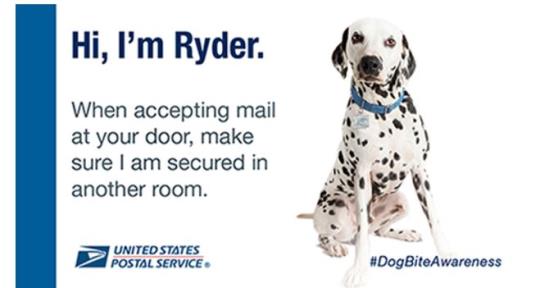
Posts for Postmasters, Managers, Safety and Heath
Managers/Safety Ambassadors, and Strategic Communications:
1. #dogbiteawareness: USPS National Dog Bite Awareness Campaign, June 2025. A few tips from @USPS: usps.com/dogbiteawareness.
2. Does your #dog love the outdoors? That’s fine by us at the Postal Service, just make sure your dog is properly restrained away from the #USPS mail carrier. #dogbiteawareness.
3. How many dogs bite carriers each year? Click this link to find out: about.usps.com/what/corporate-social-responsibility/activities/dog-bite-awareness.htm.
4. Tracking packages on usps.com will give you a timeframe for when your #USPS mail will be delivered. When mail is out for delivery, be sure your dog is secured so it won’t be a threat to your mail carrier. #dogbiteawareness.
5. When you see your mail carrier every day, make sure your dog is secured. #dogbiteawareness.
Postmaster and Manager Outreach Speech to Students
Dog Attack Prevention Speech for School Children — Grades K-2
[Make the presentation light and fun. Even though this is a serious subject, children will respond to a friendly and approachable adult.]
Good morning boys and girls. My name is [Name] and I’m your postmaster. [Tell the children what a postmaster is/does.]
I am here today because I have a message from Postal Pup! [Open a letter in an envelope with this message.]
Postal Pup needs your help!
I am going to read you a message from Postal Pup:
Hello Kids! Postal Pup here! Your mail carrier loves delivering your mail but sometimes your furry friends can make it a bit challenging. Some mail carriers have to go to the hospital because of dogs in the neighborhood and that’s no fun, right? As dogs, we love our human families, but when we see the mail carrier, we can get overprotective.
Help keep everyone safe by remembering this safety slogan: “When you see your mail carrier every day, make sure your dog is put away.”
If you are in your yard and the mail carrier wants to hand you a letter, what does that look like to you?
[Reach to a child and hand them a “letter”— wait for excited response.]
I know it seems okay and exciting, but your dog doesn’t know you’re okay. If your dog doesn’t know you’re safe, he might bite the mail carrier. Ouch! You must let your mail carrier place the mail in your mailbox.
Our job as dogs is to protect each and every one of you, the ones we love. Sometimes when we are overprotective, we bite the mail carrier to protect you. Some days, we are tired, cranky, or hungry and we get into a bad mood — just like our human families.
A lot of mail carriers are being bitten by dogs each year, and I need your help to make sure your mail carrier is safe. The best way to keep your mail carrier safe is to make sure your dog is away from the door when the mail carrier comes to deliver the mail. Remember the safety slogan: “When you see your mail carrier every day, make sure your dog is put away.”
If you go outside, make sure your dog doesn’t get out. Always close the door behind you when you leave the house. If you are outside with your dog, make sure your dog is away from the mail carrier and on a leash so the mail carrier cannot get hurt. Always be kind to your dog and all dogs.
Your best friend always, Postal Pup
[Close the letter in an envelope and end with this message.]
Take these safety tips home and share them with your family. Lastly, as a way to remember this safety talk — say it with me: “When you see your mail carrier every day, make sure your dog is put away.”
Thank you for letting me speak to you today. Have a great and safe rest of the year!
Coloring Page for Students
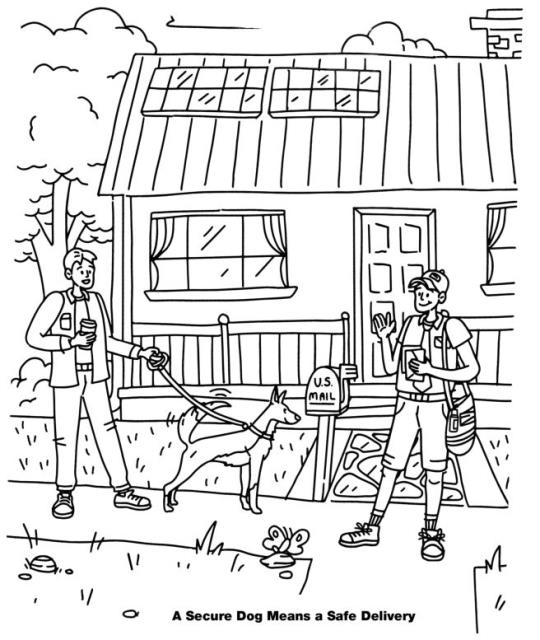
Postmasters and managers can use the coloring page as a fun, informative way to raise awareness about dog bite safety. Children can bring their artwork home to their parents for discussion. Also, postmasters and managers can collect artwork to display in the lobby or on the workroom floor for carrier encouragement.
Glossary
City Carrier: An employee who cases, delivers, and collects all mail classes along a city route by walking or driving to residences and businesses within an area authorized for city delivery service.
City Carrier Assistant (CCA): A non-career employee who alternates for regular City Carriers.
Curtailed Mail: The temporary, non-delivery of mail to a customer in cases where the premises are hazardous (e.g., an unrestrained dog).
Customer Service Supervisor: Supervisor who oversees the sorting and delivery of incoming and outgoing mail and parcels at local Post Offices.
Dog Owner’s Responsibility: It is the dog owner’s responsibility to control the dog. Most communities have ordinances for the control of dogs.
Dog Repellent: Dog repellent is to be used on any dog that attacks. The repellent consists of 0.35 percent oleoresin capsicum (extract of cayenne pepper) and 99.65 percent mineral oil, propelled by an inert gas contained in an aerosol spray can.
Dog Warning Card: Card that alerts your CCA/RCA or Carrier Substitute that a dog is at the address.
Job Safety Analysis: A procedure that reviews a specific task to uncover hazards or accident-producing situations.
Mailbag: See Satchel.
Mobile Delivery Devices (MDDs): A device letter carriers use to scan packages to confirm delivery. MDDs include a feature that allows carriers to indicate the presence of a dog at an individual address. This is especially helpful to substitutes who fill in for letter carriers on their days off.
Non-delivery of Mail Policy: Collection and delivery service personnel are to report the name and address of the customer where such interference occurs to the postmaster or authorized supervisor, who must immediately telephone the customer (if possible) and request that the animal be confined during the usual delivery hours in the neighborhood. The postmaster or authorized supervisor must further inform the customer that:
n No deliveries will be made until this is done; and
n Service will be restored upon assurance that the animal will be confined.
Officer in Charge (OIC): A career employee appointed temporarily to fill a postmaster vacancy during which the accountability of postmaster is transferred to that employee.
Package Pickup: Available on usps.com, customers can let the organization know if a dog is present at the customer’s address. USPS® will send the information to letter carriers’ MDDs.
Parcel: Mail that does not meet the mail processing category of letter-size mail or flat-size mail. It is usually a package or an item enclosed in a mailing container, such as a carton.
Postmaster: The manager in charge of a Post Office®.
Postmaster General: The chief executive officer of USPS, who is named by and serves at the pleasure of the Board of Governors. As a member of the Board, this officer appoints the Deputy Postmaster General jointly with the Board.
Rural Carrier: An employee assigned to case, deliver, and collect mail using a vehicle along a rural route and to provide most services available at a small Post Office.
Rural Carrier Associate (RCA): A non-career bargaining unit employee assigned as a leave replacement on rural routes during the absence of the regular rural carriers.
Satchel: A general term for the pouch carriers use to carry mail. Sometimes used informally to describe a carrier’s mailbag. As of 2002, many carriers prefer the traditional single satchel, which offers better protection from charging dogs.
Warning Letter: Letter to alert dog owner(s) to the possible loss of mail delivery if they do not restrain their pets.
Area Corporate Communications Managers
For media or public relations questions, contact the Corporate Communications manager for your area:
Government Relations Representatives
Government Relations representatives are here to help contact and invite elected officials for events. They can be reached at 202-268-XXXX. You can find their extensions (XXXX) using the following link: blue.usps.gov/grweb.
2024 Dog Attack Rankings by City
For the 2024 Dog Attack Rankings in your specific city or town, please contact your local Corporate Communications representative at about.usps.com/newsroom/media-contacts/local.htm. Here are the top rankings comprised of 38 cities.
Calendar Year 2024
|
|
City
|
# of Dog Bites /
Dogs
|
Rank by Count
|
Top 20 by Number
|
1
|
Los Angeles, CA
|
77
|
1
|
1
|
2
|
Houston, TX
|
65
|
2
|
2
|
3
|
Chicago, IL
|
57
|
3
|
3
|
4
|
Saint Louis, MO
|
47
|
4
|
4
|
5
|
Cincinnati, OH
|
44
|
5
|
5
|
6
|
Dallas, TX
|
43
|
6
|
6
|
7
|
Kansas City, MO
|
40
|
7
|
7
|
8
|
Cleveland, OH
|
40
|
7
|
7
|
9
|
San Diego, CA
|
35
|
8
|
8
|
10
|
Denver, CO
|
34
|
9
|
9
|
11
|
San Antonio, TX
|
32
|
10
|
10
|
12
|
Philadelphia, PA
|
32
|
10
|
10
|
13
|
Detroit, MI
|
32
|
10
|
10
|
14
|
Columbus, OH
|
32
|
10
|
10
|
15
|
Minneapolis, MN
|
30
|
11
|
11
|
16
|
Indianapolis, IN
|
26
|
12
|
12
|
17
|
Phoenix, AZ
|
25
|
13
|
13
|
18
|
Memphis, TN
|
25
|
13
|
13
|
19
|
Omaha, NE
|
24
|
14
|
14
|
20
|
Louisville, KY
|
24
|
14
|
14
|
21
|
Rochester, NY
|
23
|
15
|
15
|
22
|
Toledo, OH
|
21
|
16
|
16
|
23
|
Sacramento, CA
|
21
|
16
|
16
|
24
|
El Paso, TX
|
21
|
16
|
16
|
25
|
San Francisco, CA
|
20
|
17
|
17
|
26
|
Oklahoma City, OK
|
20
|
17
|
17
|
27
|
Milwaukee, WI
|
20
|
17
|
17
|
28
|
Albuquerque, NM
|
20
|
17
|
17
|
29
|
Stockton, CA
|
18
|
18
|
18
|
30
|
Oakland, CA
|
18
|
18
|
18
|
31
|
Youngstown, OH
|
17
|
19
|
19
|
32
|
Salt Lake City, UT
|
17
|
19
|
19
|
33
|
Pittsburgh, PA
|
17
|
19
|
19
|
34
|
Miami, FL
|
17
|
19
|
19
|
35
|
Des Moines, IA
|
17
|
19
|
19
|
36
|
Saint Petersburg, FL
|
16
|
20
|
20
|
37
|
Fort Worth, TX
|
15
|
20
|
20
|
38
|
Birmingham, AL
|
15
|
20
|
20
|
— Occupational Safety and Health,
Human Resources, 5-29-25



