Each election cycle presents a different set of parameters for ballot creation and for the size and weight of the return Ballot Mail envelope. As a result, many voters do not know the correct amount of postage required to return their ballots by mail. Election officials must consult with a Manager Customer Relations to determine the proper postage required for outbound Ballot Mail sent to voters and for voters mailing back return Ballot Mail to election officials.
Election officials are required to indicate in a prominent location the proper amount of First-Class Mail® postage that must be applied to balloting materials for any election, whether sent in hard copy or electronic formats. An exception may apply in certain circumstances for balloting materials for military and overseas voters or where postage is prepaid. See Domestic Mail Manual (DMM 703.8.3®) to learn more about the postage marking requirements.
Key Messages
Even in times of war, the Postal Service has delivered the most fundamental symbol of democracy — a ballot – to those who serve in the U.S. Armed Forces as well as other overseas non-military voters. The key messages here are:
n Any American voter living overseas can mail his or her completed ballot back to the United States free of charge at the nearest American embassy, consulate, or Diplomatic Post Office (DPO) under the Uniformed and Overseas Citizens Absentee Voting Act (UOCAVA). UOCAVA is a federal law that provides uniformed and overseas citizens the ability to register and vote absentee in elections for federal offices.
n If an overseas voter has authorized access to a military base, he or she can mail a ballot free of charge at the nearest APO or FPO.
n For the 2026 general election, special procedures for APO/FPO/DPO absentee ballots are in effect between September 1 and November 30. During this time, the Postal Service will provide special handling for dispatch via the International Service Centers (ISCs).
n The Postal Service recommends military voters go to fvap.gov/eo/overview for return Ballot Mail dates.
The Postal Service and the Military Postal Service Agency collaborate to provide special handling of Ballot Mail sent to absent uniformed services voters with UOCAVA-authorized APO/FPO/DPO addresses. The Postal Service is committed to ensuring that everyone who votes by mail experiences an efficient process.
Here is a summary of special procedures for Ballot Mail addressed to APO/FPO/DPO locations only:
n Election officials must mail absentee ballots at least 45 days before the November 3, 2026, election.
n Local election offices must segregate military Ballot Mail to the Chicago ISC and the Miami ISC gateways. At ISCs, Ballot Mail receives special handling, including accelerated sortation, special tray identification, and priority transportation.
n APO/FPO/DPO destined Ballot Mail will be sent from local Post Office™ locations to the nearest Processing and Distribution Center for further handling.
n Postal Service employees will identify trays or containers of Ballot Mail using Tag 191, Domestic and International Ballots, and present them to the Post Office facility.
Absent overseas uniformed services voters with UOCAVA-authorized APO/FPO/DPO addresses can return Ballot Mail via Priority Mail Express® using Label 11-DOD, DOD Express Mail Label Absentee Ballot. The label includes “Waiver of Signature” and “Guaranteed by End of Day” endorsements, so absentee ballots can be delivered the day they arrive at the destination Post Office™.
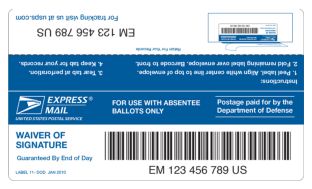
Familiarize yourself with the following operational guidelines for Label 11-DOD:
n The Military Postal Service Agency distributes Label 11-DOD overseas.
n Label 11-DOD is only for voted absentee ballots from overseas U.S. military and authorized UOCAVA civilian citizens.
n The label may only be used by eligible voters when the return absentee ballot is mailed from a Military Post Office (MPO) or DPO overseas.
n To use Label 11-DOD, overseas U.S. military and authorized UOCAVA civilian citizens must return their ballots via APO, FPO, or DPO locations.
n Eligible voters may use Label 11-DOD on any size Ballot Mail envelope and must always affix it in the upper right corner.
n Voters keep part of the label in order to use the tracking number to track their Ballot Mail.
n At ISCs, Ballot Mail receives special handling, including accelerated sortation, special tray identification, and priority transportation Ballot Mail arrives by international transportation at one of the Postal Service gateway offices for Customs clearance and initial processing at select designated offices.
n At these facilities, the mail is processed by postal automation equipment in an initial domestic sort for distribution throughout the United States.
The Official Election Mail logo is a unique registered trademark designed exclusively for inclusion in the design of Election Mail.
The Official Election Mail logo may be used on any mailpiece that is created by or on behalf of an election official and that is mailed to or from a citizen of the United States for the purpose of participating in the voting process. This includes ballots, sample ballots, voter registration cards, absentee voting applications, and polling place notifications. The logo may be used on qualifying mailpieces in all classes of mail and all processing categories; however, it is not intended to substitute for postage.
When the Official Election Mail logo appears on a mailpiece, voters recognize the mail as important and distinct from partisan political mailings. Additionally, the logo serves to identify Election Mail for Postal Service workers and distinguishes it from the millions of other mailpieces that are processed daily.
The Postal Service encourages election officials to use all available tools to improve the visibility of their Election Mail within the postal network. In particular, it strongly recommends the use of the Election Mail Checkboxes in PostalOne! processing to get increased visibility of Election Mail in the mailstream. In July 2024, the existing Election Mail Checkbox was separated into two boxes: Election Mail – Official Ballots and Election Mail – Non-Ballot Materials.
Please check the “Election Mail – Official Ballots” or “Election Mail – Non-Ballot Materials” box for each mailing presented for acceptance. This provides the Postal Service with important insight into Election Mail and Ballot Mail volume by entry point that may help with future Postal Service capacity planning.
The Postal Service provides free means of electronic postage statement submission through the IMsb Tool and Postal Wizard. There are also approved third-party software options available on PostalPro at postalpro.usps.com/node/248.
A serialized Intelligent Mail® barcode (IMb®) is a 65-bar Postal Service barcode used to sort and track letters and flats. The barcode simplifies data-gathering by consolidating information for multiple Postal Service identifiers into one comprehensive location. Using a serialized IMb also expands mailers’ ability to track individual mailpieces and gain greater mailstream visibility.
Uniquely serialized IMbs facilitate the tracking of individual ballots to and from individual voters. A serialized IMb can be applied to most Election Mail and is critical for using IV-MTR service.
The IV-MTR application provides information about when and where the Postal Service sorts a mailpiece on mail-processing equipment. A serialized IMb can also be used for address correction services: manual address correction notices, ACS, OneCode ACS®, and Intelligent Mail Full-Service ACS™.
Service Type Identifiers (STIDs) are unique 3-digit codes that indicate the service type, mail class, and address correction service (if any), for an individual mailpiece, and are a part of the IMb. As part of an IMb, STIDs offer mailers near-real-time tracking visibility on both outbound and return mailpieces. STIDs also provide the Postal Service with enhanced tracking capabilities that allow us to quickly identify and process on-hand ballots throughout the mail network.
These specifically designed STIDs have proven instrumental in identifying and tracking mail.
Note that the Ballot Mail STIDs are not for all Election Mail. For Election Mail that is not a ballot (e.g., voter registration applications, polling place locations, ballot applications, and sample ballots), use the appropriate STID for the mail class, as well as Address Correction Service (ACS™) and IV-MTR services desired that are identified for First-Class Mail or USPS Marketing Mail in the STID Table.
To assist election officials and their mail service providers with selecting an appropriate Election Mail and Ballot Mail STID for their outbound mailings, the Postal Service offers created the Election Mail and Ballot Mail STID Finder: postalpro.usps.com/stid-tool. The tool asks users to answer a series of yes/no and multiple-choice questions related to the main attributes that determine which STID may match the mailer’s needs. It is important to bear in mind that the tool’s results are suggestions only. This tool ONLY supports Election Mail and Ballot Mail. All other types of mailings must refer to the full list of STIDs available on Postal Pro postalpro.usps.com/mailing/service-type-identifiers.
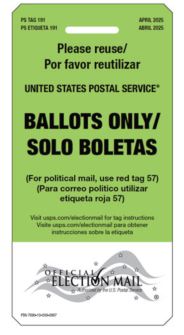
Tag 191, Domestic and International Ballots, may be used by election officials to identify trays and sacks of Ballot Mail destined for either domestic or international addresses. The green tag provides greater visibility to containers of Ballot Mail as they enter processing and distribution operations. An updated version of Tag 191 (shown here) will be entered into circulation this election year. The tag dated April 2025 features the same text on both sides and has English and Spanish translations, whereas the tag dated July 2007 had different faces and was written only in English. Both versions of the tag remain valid. Please exhaust the existing tags on-hand. Business Mail Entry Units (BMEUs) will continue to accept and affix both versions of the tag since they are reusable.
Tags are available at your local Business Mail Entry Unit (BMEU), which can be found at postalpro.usps.com/node/1623. To order online, use the order form linked here: about.usps.com/forms/ps1910.pdf.
The tag cannot be used to identify containers of other types of Election Mail, such as sample ballots, voter registration notices, absentee voting applications, or polling place notifications. Tag 191 also may not be used for Political Mail.
Tag 191
The Postal Service strongly recommends an MDA review all Election Mail ballot envelopes and other Election non-ballot mailpieces before printing. We recommend that election officials consult an MDA each year to review new and previously approved mailpiece designs. MDAs are experts on Postal Service mailpiece design standards and can provide guidance on pieces that meet the Postal Service’s requirements, answer questions about mailpiece design, give advice on evaluating mailpieces for automation discounts, and provide technical assistance on the Postal Service’s mailpiece standards.
For assistance, election officials can submit a design review request at electionmail.usps.com/s/election-mail-review or call 877-672-0007 (select option 3 for mailpiece design). Hours of operation are Monday through Friday, 7 A.M. to 7 P.M. Central Time (closed federal holidays). Additional mailpiece design information is available online at postalpro.usps.com/mailing/mailpiece-design-analyst-mda-customer-service-help-desk.
The Postal Service continues to recommend that election offices use First-Class Mail for outbound Ballot Mail sent to voters. Using First-Class Mail allows for faster service while maintaining high visibility as the Ballot Mail moves through the mailstream (when used with USPS visibility tools, like serialized Intelligent Mail barcodes). Nevertheless, it has been the longstanding practice of the Postal Service to prioritize Ballot Mail that is entered as USPS Marketing Mail, regardless of the paid class, when capacity permits and when the mailpiece is identifiable as Ballot Mail by green Tag 191 or other Postal Service visibility indicia.
Qualified Business Reply Mail™ (QBRM™) is a First-Class Mail service that enables election officials to pay the return postage (including a per piece fee) for Ballot Mail returned by the voter to election offices through the mail.
The reply mail envelopes that election officials distribute must conform to a specific format, including use of a unique ZIP+4® assigned by the Postal Service. QBRM proofs must be approved by the Postal Service and bear an IMb. QBRM can be applied only to automation-compatible cards and letter-size mail weighing up to and including 3.5 ounces.
Approved QBRM mailers can enhance Election Mail processing capability with Intelligent Mail barcode Accounting (IMbA™). IMbA is an automated solution for the counting, rating, invoicing, and billing processes. Customers who participate in IMbA will have their mail processed and invoiced directly from the mailpiece equipment, bypassing manual handling in the delivery office. Invoicing is sent to PostalOne! daily. For more information on QBRM with IMbA, see DMM 505.1.6 at pe.usps.com and the information sheet on Postal Pro at postalpro.usps.com/node/7399.
Informed Delivery® is a secure, free, and optional feature that can help election officials connect with voters by providing eligible residential, business, and P.O. Box consumers with a digital preview of their household’s incoming mail and the ability to manage their packages all from one location.
Users can view grayscale images of the exterior (addressed side) of automation-processed, letter-sized mailpieces via a morning Daily Digest email or at any time via the online dashboard from your phone, computer, or the Informed Delivery Mobile app.
Nearly 75 million users are already signed up, with an average email open rate exceeding 60 percent. The Postal Service’s Informed Delivery feature continues to deliver on its value proposition to election officials by providing the opportunity to reach more voters, target and increase interaction with users, encourage responses to voter engagement campaigns, reach customers digitally from their physical locations, and gain more returns on Election Mail campaigns.
A digital preview of the exterior of Election Mail offers benefits to both election officials and voters. Election officials are able to increase voter interaction with their mail and generate faster response rates. At the same time, voters have a more convenient and secure experience because they can see when their Election Mail will arrive. Learn more about Informed Delivery at usps.com/business/informed-delivery.htm.



